Facebook

Showing posts with label Eaton. Show all posts

Tuesday, November 19, 2013

Many Rivers to Cross - MY Priscilla

     Ever since the first episode of the PBS series, The African Americans: Many Rivers to Cross, which was created by Professor Henry Louis Gates, Jr., I’ve been pondering this blog post.  I’ve wanted to write, but each time I’ve tried, the words seemed stifled because of the lack of information I have about the subject of this essay.  You see, in Episode 1, Dr. Gates shared with viewers the story of Priscilla, a young girl who was purchased at a South Carolina slave auction by rice planter, Elias Ball.  In response to this episode, many in the blogging community have written beautiful, expressive posts about “their Priscilla”.  But, for me, doing so presented an awkward challenge.  Why, you might ask?  Well, because I have a real-life Priscilla, and she has been one of my most challenging ancestors to research.
    Prescilla Yarborough was my great-grandmother.  She was born in May of 1844, reportedly (by Census) in North Carolina (although one document, my grandfather's death certificate, says she was born in Virginia), and she died after 1900, but before NC began recording death certificates in 1913. She was enslaved. She had at least two granddaughters who were named for her: Priscilla "Trookies" Yarborough (my father's half-sister), and Evelyn Precilla Yarborough (daughter of Calvin and Prescilla's youngest son, Eugene). At this time, that's all I know about MY Prescilla.
     I list Prescilla in my family tree as Prescilla SHAW, because that is how her name is given on the cohabitation record for her marriage to my great-grandfather, Calvin Yarborough.  However, I have also seen her maiden name given as Eaton, on one of her children’s death certificate, and White, on another.  All others either give her name as Shaw, or unknown.

On August 25, 1866, Prescilla and Calvin recorded their marriage date as December 27, 1860.  By that time, they’d had the first three of their 11 children together.

Cohabitation Record for my great-grandparents, Calvin and Prescilla Yarborough
Transcription: 124 North Carolina Franklin County August 25th AD 1866
Before me TC Horton Clerk of the County Court for said County personally appeared Calvin Yarbro and Priscilla Shaw residents of said County lately slaves but now emancipated and acknowledge that they do cohabit together as man and wife and that said cohabitation commence 27th Dec 1860
                                                                                                                TC Horton Clerk


My grandfather's death certificate, showing that my grandmother gave Prescilla's name as White, and said she was born in Virginia.  I have noticed, though, that these two items appear as though they were added by someone after the orginal was written.  I've pondered this with folks at the NC State Archives. So far, no one has any answers.
Although I don’t know anything else about Prescilla, she is the ancestor whom I believed most purposefully, and pointedly left me a genealogical gift for my research.  This gift, I believe, was in the naming of her children.  You see, many of Calvin and Precilla’s offspring have middle names that are the surnames of local families in and around Franklin County, NC, where they lived.  I believe that Precilla was most likely separated from her family, and my sense is that she may have never seen them again, once that separation took place.  I also, believe that she, like Calvin, may have had a series of owners, and she wants me to know who they were, so that maybe I can find her (my) family. 
These are the (known) children of Calvin and Prescilla YARBOROUGH, with their middle names capitalized:
  •             Louis NEAL Yarborough (1862-1931) - Calvin was owned for most of his slave years by the Neals, and I believe that his father may have been, also, but I haven’t been able to prove that the Louis in the inventory was actually his dad. He became a Yarborough slave by marriage, just a few years before emancipation
  •      Samuel EATON Yarborough (1864-1922) – The EATON family was prominent in Franklin and surrounding counties.  I believe Precilla may have been owned by one of them, perhaps William Eaton, whom I’ve written about in earlier posts, re: Letters from Louisburg.
  •      Sarah H Yarborough (1866-1870) – Sarah was “burned” and died at age 4, according to the 1870 Mortality Record for Franklin County. I believe that Precilla may have been once owned by Sarah Helen Shaw, and that she may have named her first daughter after her.  However, I also often wonder if she may have been named Sarah after either Priscilla or Calvin’s mother.
  •      Thomas W Yarborough (1867 -?) – I’ve never seen what the W stands for in Thomas’ name, but I have to wonder if it might be, “White”, since one of the children gave that as Precilla’s maiden name
  •       Henry KING Yarborough (1872-1936)  – The King family was also prevalent in Franklin County.  Sarah Shaw, who I believe may have once owned Precilla, married Joel KING.
  •      Quinea A Yarborough (1874 -?) – I don’t know what the A stands for in this name.
  •        Caroline or Carolina B Yarborough (1876-1914) – Again, I don’t know what the middle initial stands for.
  •      Jose -phine S Yarborough (1878 -?) – I have no way of knowing, but could this be SHAW  
  •      Mattie Louise Yarborough (1879-1919
  •      Calvin Roy Yarborough (1882-1929) – This is my GRANDFATHER. There are ROYs in the area, but I’m not sure if there is any connection
  •      Eugene CARTER Yarborough (1864-1954) – This is the most vague (to me) of all the middle names.  The CARTER surname doesn’t appear in Franklin County until 1880, but because I don’t know where Precilla came from, originally, I won’t rule anything out.
*  I’ve noticed that (if my naming theory is correct), Prescilla seems to only use it with her sons, and not so much her daughters.  I wonder if the daughters were named for particular people?

     Nothing remains of my great-grandmother, Prescilla, except for my belief that she left me these clues in the naming of her children.  There are no family stories about her, nor heirlooms which belonged to her. Nothing.

     Thank you, Great-Grandma Precilla, for giving your children these names.  I promise not to ever give up trying to follow the trail you’ve left for me to explore.

Renate

Sources:
Yarborough Family bible, owned by Susie Yarborough Hawkins, Louisburg, NC
Cohabitation Records, Franklin County, 1866: North Carolina State Archives, Raleigh, NC
Franklin County Death Certificates: Franklin County Register of Deeds, Louisburg, NC

Sunday, January 22, 2012

Amanuensis Monday - Letters from Louisburg, Part 3

I have been posting a series of letters written by one, William A. Eaton, of Franklin County, North Carolina, to officials at the Bureau of Refugees, Freedmen, and Abandoned Lands over the course of a few months in 1865.  I ran across these letters during a visit to the National Archives in Washington, D.C., while searching for any mention of my great-grandfather, Calvin Yarborough, a former slave who'd been notated in the 1870 Census as a "former schoolteacher".  Since the Freedmen's Bureau was instrumental in helping to establish schools for "colored" children after Emancipation, I wanted to see if my ancestor's name might be mentioned in any of the correspondence to/from Franklin County.  Although my great-grandfather wasn't mentioned by name in these letters, I still felt a connection to him through these letters, because the "poor, colored" folks the writer so often refers to include many of my ancestors, including (most certainly), my great-grandfather, Calvin. Not only that, but in another letter, which I took a picture of with my camera, but don't have a full copy of to transcribe, Mr. Eaton uses as an example the slaves of one widow, Mrs. A.J. Yarborough.  This Mrs. Yarborough was the widow of my great-grandfather's last owner, James H. Yarborough, and was thence Calvin's owner at the time of Emancipation.
This is the final letter of the three I copied, although there were several more on the microfilm.  (Click to read Part 1 and Part 2.)  Whenever I return to the NARA, I will try to get copies of those missing, which include responses from some of the officials Mr. Eaton was writing to.


Louisburg Sept 25th 1865


Col E Whittlesey


Dr Sir
     I wrote you in answer to your favour of Aug 12th about three weeks past, and as your letter was 18 days coming from Raleigh to Louisburg, I thought it posible my letter did not reach you at all, therefore I write you to know if you received my letters.
     If it is posible to take any steps towards buildng up a home for the colored people, or freedmen, the sooner we begin about it the better for I see that as the year nears to a close, the poor creatures are runing more and more into a state of confusion, without homes. And (without) any person to guide or advise them it is now difficult to keep them at home long enough to gather in the growing crop, part of which is now ready to be gathered.  Some of them are really in a deplorable situation, it being out of power of any person to govern them.  It will be utterly imposible for the White people to feed them in their present condition.  Have you made


pg 2


up your mind what shall be done with the children that have no parents.
     Please let me hear from you at your earliest convenience. Should you think it desirable to have a personal interview with me, I will come to see you, but I would greatly perfer seeing you at my house, and if you can come out, I will meet you any day you will appoint at Franklinton and bring you out.


                                                                                                       Very Respectfully
                                                                                                                     Your Obt St
                                                                                                                     W A Eaton


About Mr. Eaton:
William A Eaton was born in 1812 or 1813 in NC.  He appears to have spent most of his life in Granville County, which is ajacent to Franklin, but once shared some of the same land. His main property appears to have been in the township of Fishing Creek (Granville). It is unclear at this time where his property was located in Louisburg.
In 1840, Mr. Eaton owned 38 slaves. In 1850, he owned 80, and in 1860, the value of his personal estate (not including real estate) was $86,900, so it's safe to assume that his attainment of human property had increased, even more.
William Eaton married the former Jean Burwell, of Mecklenburg, Virginia in 1840.  He died of paralysis in 1870 (in Louisburg) at the age of 58.


Source Information:
Ancestry.com.
Virginia Marriages, 1740-1850 [database on-line]. Provo, UT, USA: Ancestry.com Operations Inc, 1999.  Original data: Dodd, Jordan R., et al.. Early American Marriages: Virginia to 1850. Bountiful, UT, USA: Precision Indexing Publishers

Year: 1850; Census Place: Fishing Creek, Granville, North Carolina; Roll: M432_631; Page: 88B; Image: 177.

Year: 1860; Census Place: Fishing Creek, Granville, North Carolina; Roll: M653_898; Page: 380; Image: 384; Family History Library Film: 803898.

United States. Nonpopulation Census Schedules for North Carolina, 1850-1880: Mortality and Manufacturing. M1805, rolls 1-5. National Archives and Records Administration, Washington D.C.


A note from the transcriber:
During the weeks I've been transcribing these letters for the blog, all of the intial feelings/reactions I had to reading them that first day at the Archives have resurfaced.  I've chosen to say little about those feelings because I don't want to skew the perspective of my readers, however, I am so very interested in hearing your thoughts!  I've received some comments on the previous posts, as well as via Twitter and email, however, I'd love to have a "conversation" of sorts with you, my dear readers, via the comments section right here on the blog.  So, please ma'am, please sir, if you are so inclined, do share a few thoughts with me about these letters?  I'm curious to hear from White and Black on this, to know how you're interpreting Mr. Eaton's words and intentions.  Of course, if you'd rather keep your thoughts private, that's your perogative, but for those who'll leave comments, I will respond to them all. :)  Let the conversation begin!

Renate

Monday, January 9, 2012

Amanuensis Monday - Letters from Louisburg - Part 2

Last Monday, I shared the first of a series of letters between William A Eaton, of Franklin County, North Carolina, and officers of the Bureau of Refugees, Freedmen, and Abandoned Lands (usually known as the "Freedmens' Bureau").  In his letters, Mr. Eaton is pleading for the support of the bureau in establishing a home, school, and working farm for former slaves after Emancipation.

I read and copied three of the letters in this series during a visit to the National Archives over a year ago.  At that time, I had no idea I'd be sharing them, so I must apologize for not having the exact source information, other than to say that the letters were on a reel of microfilm which held records of the Freedmens' Bureau which related to Franklin County, NC.  My purpose in reading through these records was to seek any mention of my own ancestors, most specifically my formerly-enslaved great-grandfather, Calvin Yarborough, Sr., who, in the 1870 Census was noted to be a "former teacher".

If you missed the first letter I posted, which was from Mr. Eaton to the first commissioner of the Freedmens' Bureau, General Oliver O Howard, you can read it by clicking here.  This second letter, penned by Mr. Eaton on September 2, 1865, is to Colonel Eliphalet Whittlesey, Assistant Commissioner for the North Carolina Freedmen's Bureau, 1865–1866.


Franklin County Sept 2d 1865


Col E Whittlesey

Dr Sir

Your letter 12th *itto reached me this day. I have read its contents carefully, and I am truly thankful that I can indulge a slight hope from your letter, that something may yet be done for the poor destitute colored people of this country, for I do assure you they will soon stand much in need of your assistance. I say of yours Colonel, because they have no one to look to but you, and unless you can enlist the General government, or some of the Philanthropic Societies at the North in their behalf, God only knows, what is to become of them.

The time is drawing near where the greater portion of the negroes will have give up their present homes, and I fear many thousands will be homeless and friendless. As things exist, it will follow as a natural consequence. Very many of our largest land holders are renting their grounds to White laborers, owing to their inability to pay high wages for Colored labour; And this will throw a great many women and children out of imployment. And then there are a great many persons, who would employ the negroes but they are fearfull that the negro, might leave them in working season, and they would loose their crops. And this will throw a good many out of homes: And the fearfull consequence


Pg. 2

must follow.. that a great many negroes will spend the most of their time runing about the country looking for day work: which will nothing like give them a support. And that good old adage will surely be about them, Idleness produces want & want, vice & vice misery.

I had a good deal of conversation with Col Clapp* on the subject of the home for the destitute. I think I can furnish an excellent tract of land for the home, and think with good management it could be made to support a great many indigent negroes. You ask if such a place can be had with suitable buildings. There are already a great many buildings on the place, but not enough to carry out the home according to the scale I would like to start one, say with a school attached, for improving the young, and giving the old proper religious instruction, both of which I consider very important. I should like to have a personal interview with you on the subject. The place I propose to sell for the home, is two plantations that lay together. The two tracks of land contain 2200 acres, if properly laid off into lots, say of from 30 to 60 acres each, with with a good family house on each. And then select some of the best families we can find settle them on these lots. I say best families because I would like to have a good example set at the beginning, it would induce others to do better.

There are now on the two places good family residences sufficient to accommodate the teachers to the school, and the manager of the farming opperations, I gave Col Clapp a full description, and particularly of the School house which is onto


Pg. 3

accommodate 500 pupils. I propose to make it a manual school. By settleing 50 or 60 families, which would consume about 1500 acres; and the remainder of the land to be worked by the pupils in the school; The two places can be purchased for Twenty five thousand dollars ($25,000) I have made a calculation what it would cost to erect all the buildings necessary to make the accommodations sufficient for 500 pupils, at my figures: all the necessary buildings will cost Fifty thousand dollars ($50,000) So you will see that land & buildings will cost ($75,000). I propose to put up every thing in neat and comely style: for unless the place was made to look like home; The colored people would not like it. I refer you to Col Clapp, for a full description for the plan. I would like to see you here; that you might see the situation. I think you would like it.

I am quite sure Col, that I could, after the frist year, make it a self supporting Establishment, and if you will have a proper agent, a goodly quantity of supplies may be collected from the farmers, from the growing crop for the indigent, if delivered to them, they will soon be waisted. And by the coming Spring, they will not have one pound of any thing to subsist on. And I fear, unless some eye is kept on the more ignorant persons among the colored people, many of them will be left without any portion, and then, what is to become of the women and children, unless they have some place to go to, and some person to look to for advice. Use your best endeavor to get a home erected for them. God grant us his assistance, in this. I believe a I hope I will meet with his approbation.


p. 4

I before said that provisions could be collected from the farmers. I mean that portion of the crop that belongs to the Orphans. And then we have a good many women who have large families, and no husband, and may as a class may be counted Orpans, for, I assure you these women and children will want as much looking after, as any Colored people in our land. take these two classes together, and they will give a large number of the destitute. I think if you will have a proper agent for the colored people, and establish a home for them, and have their provisions collected to gether, and have some system in the use of them a large sum will be saved to the general government.

For unless you have some place for them to collect they will all be puring into your at Raleigh by the 1st of January, and in a very short time the fuel a lone would cost as much as the home would. And at this home, they can have wood without allowance, and comfortable houses to live in, many of them made to support themselves. By strict vigilance over them, many of them who would always live in idleness if left a lone, would be induced to work where every body was at work around them. But some of them would have to be made to work or they will die in idleness


pg. 5

Let me speak a little more plainly on the subject of an agent for the colored people, and I hope you will pardon my freedom of speech on that subject.

The time will soon be here when the crop is to be gathered in, and then come the division of the crop; A great many of the white people are perfectly willing that the Negroes should have an equitable part. But on the other hand I fear there are a great many who will try to make the negroes part as little as possible. Will it not be important to have an agent for them, who is well acquainted with the customs of the country; and likewise to be able to judge under the present circumstances what part of the crop ought to be paid to the negro for his services. This agent ought to be carefully selected, and ought to be required to give his entire time and personal attention to this business, for I assure you he will find, a full amount of business for any one man to attend to. If one man can do it, after the crops are divided between the whites & Blacks, some attention will have to be bestowed on the 2d division, say among Blacks themselves. For the stronger will be sure to try to get a full share and leave the orphan out and those orphans Col, must have some one to care for them. And you will find a great many in every county. We have in our family some 6 or 8 who will be destitute in deed if you do not have them looked to be some one, and have some place to send them to, some place of safety for them


p. 6

I only cast these hints that you may think of what ought to be done in the premises.

If you can possibly come to Franklin I would be pleased to come out, for I am sure if we could see each other, we could make some arrangements for the home. If you conclude to come, give me a weeks notice. Your letter was 18 days on the road. Let me hear from you at least.

I am very Respectfully

Your most abl St

W A Eaton

*Lieutenant Col Clapp – Superintendent of the Central District of the Freedmen’s Bureau


To read the final letter in this series, click here: 

Monday, January 2, 2012

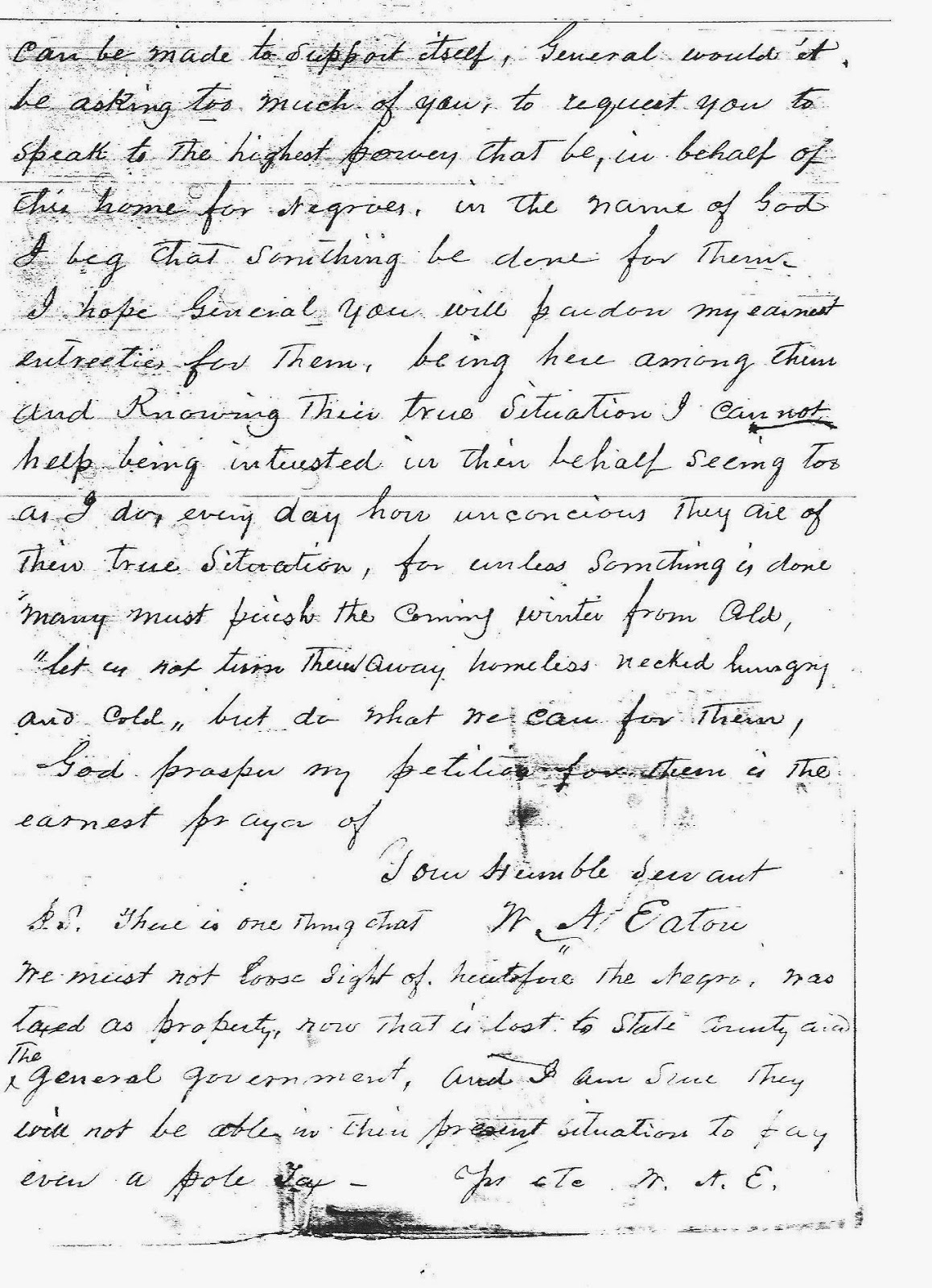
Amanuensis Monday - Letters From Louisburg (Part 1)

During a visit to the National Archives last year, while searching records from the North Carolina division of the Bureau of Refugees, Freedmen, and Abandoned lands for any reference to my great-grandfather, Calvin Yarborough, I ran across a series of letters (on microfilm) between William A Eaton, a respected citizen of Franklin County, NC, and certain officials from the bureau.  Mr. Eaton was concerned about what was going to become of Franklin County's formerly enslaved population, once they were fully and completely on their own, following Emancipation.  Without adding my (perhaps) biased opinions/reactions to this line of correspondence (given my family's roots in this county), I will present the three letters I chose to copy, beginning today, and then on each of the next two Mondays.

In this first letter, Mr. Eaton is writing to General Oliver Otis Howard, the first Commissioner of the Freedmen's Bureau. He had previously written a letter to the General, expressing his concerns, and the General had written him back.  What follows is Mr. Eaton's response.


Louisburg

Franklin County N.C. Aug 1865

Genl O O Howard

My Dear Sir

Your very kind letter 22 xxxx, was recd a few days past. And I hope you will pardon me for trespassing again with an other letter. The only excuse I can make General, is thae hope of getting something done for the poor colored widow & Orphans, many of wom must be left to starve unless you can be enlisted in their behalf. General you are the only hope they have on earth. It is generally believed they are committed to your care, and let me entreat you to try and get something done for them. Unfortunately a great many of the colored women have large families of children without a husband and a great many will be totally unable to feed and cloth themselves & children when they are given up by their former owners, which the former owners will be compelled to do, at the end of the present year. Nearly all the men will set up for themselves and leave the women & children to shift for themselves and many of them were formerly owned by widows......

pg. 2
and Orphans, who have no home. The negros are xxx hired, and the 1st day of Jany (January) coming will find them homeless & friendless, unless the government will ___ forward to their relief. You say in your letter General that Franklin County will have to take care of its own paupers. General if every white (probably citizen) in this county, was taxed to his full capacity ___ could not take proper care, of the pauper negros that will be turned on the county the frist (sp) Jany next But General I do not propose to make this altogether a county institution, the reason why I ask to have it under th especial care of the general goverment (sp) is that when ever the agent for freedmen for the state, finds a fit subject for his special patronage he may have a place to send him to where they can have proper care taken of them, and if we can get one such institution started in the South it will beget many others of like character. In the present crippled state of this country I fear it would be a hopeless job to raise money to establish an institution of any kind much less for such a one as I propose. Many persons think it best to keep the colored rase (sp) in

pg. 3
as much ignorance as posible. I beg leave to differ with them. I wold to God that every man woman & child in these United States were well educated, and piously instructed, and properly point the way to the Lamb of God, and how can that be done, unless Gods more enlightened children, will help to lift these poor people from the darkness that now surrounds them; I have written to Col Whittlesey* and invited him to visit me that I may lay my plan before him: I think it the cheapest plan that can be adopted to do any good. The land that I propose to get for the purpose belongs to 5 persons but all lying in one compact body, and if laid off and adjusted with skill, would accommodate a great many negroes, andif provisions are laid in at the begining of winter may be done to advantage If Col Whittlesey allows the negroes to remanin in and about Town the wood for them would cost quite as much as the home for them, here they can furnish their own wood, and by proper encouragement a great many may be enduced to support themselves. With one years start the place

*Col Whittlesey was the Commissioner for the State of North Carolina Bureau of Refugees, Freedmen, and Abandoned Lands

pg. 4
can be made to support itself. General would it be asking too much of you, to request you to speak to the highest powers that be, in behalf of this home for Negroes, in the name of God I beg that something be done for them. I hope General you will pardon my earnest entreeties for them, being here among them and knowing thir true situation I can not help being interested in their behalf seeing too as I do every day how unconcious they are of ther true Situation, for unless something is done many must perish the coming winter from cold. “let us not turn them away homelss necked hungry and cold” but do what we can for them. God prosper my petition for them is the earnest prayer of
                                                                                                                       Your Humble Servant

                                                                                                                      W A Eaton


P.S. There is one thing that we must not loose sight of, heretofore the Negro was taxed as property, now that is lost to state county and the general government, and I am sure they will not be able in their present situation to pay even a pole(poll) Tax -

                                                                                                                         ps cte   W.A.E.

To continue to read the next letter in this series, click on the links below: