Formerly, "Just Thinking", this blog presents the thoughts and experiences of a family historian working to demystify the past and uncover the stories of an elusive ancestry. NC surnames are YARBOROUGH, NEAL, GREEN, HAWKINS, DUNSTON, DAVIS, BROWN, ROSS, HILL, BRYANT, and DAVENPORT in Franklin, Warren, Halifax, and Tyrrell Counties.
With so much of my family's history shrouded in darkness, is my personal mission to uncover the hidden details of my ancestry and bring them INTO THE LIGHT.
Facebook
Showing posts with label franklin county. Show all posts
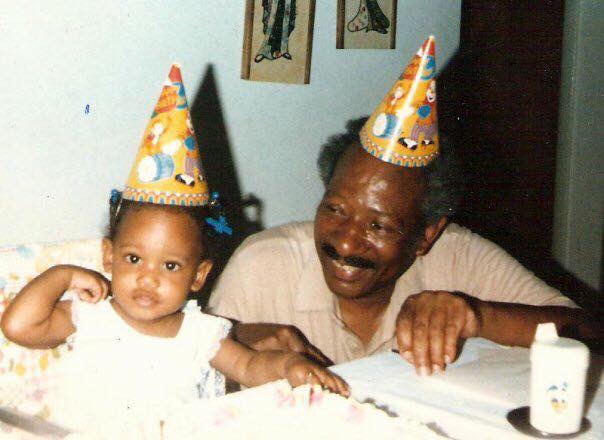
Well, so far so good. It's Week 3 and I'm still on track with the #52Ancestors Challenge! This week's prompt is "favorite photo." That's kind of a tough one, for me, because I have so many beloved photos! However, I've decided to narrow it down to two that always make me smile; and that, despite the fact that I don't have an actual personal memory of when they were taken, both photos hold a special and very endearing place in my heart.
My Favorite Photos
Both of these photos were taken at the same location - at my grandmother's home in Louisburg, NC. It's my understanding that I lived there with my paternal grandmother, Anna Green, from sometime in my infancy, until I was a toddler - around two years old. If that's true, I'm guessing that perhaps the first photo, showing me with my brother, Arthur, may have been taken when my parents brought me to Louisburg, from Ohio; but, I really don't know. Arthur and I are on my grandmother's bed, where I always slept (with her) in later years, when I would spend part of my summers there. I remember that bed very well. (It was actually one of two in the room, because my Aunt Sue slept in there also, before she married and moved to New York.)
This is me (right) with my brother, Arthur, on our grandmother's bed in Louisburg. We were 17 months apart, and the best of friends. Sadly, Arthur died (of liver cancer) when he was 23 and I was 22.
This second photo was also taken at the Louisburg house, but this time in the "front room," most certainly on one of our Sunday trips to Grandma's house, with all 6 of us (parents, 3 brothers, and me) packed into our blue and brown station wagon for what is now a 2 hour and 45 minute drive, but was most certainly closer to 4 hours in the 60s and 70s. I do have very vague memory of my maternal grandmother, Mary Thomas, traveling with us a time or two - and here I have photographic proof that it actually happened! Grandma Thomas lived just "across the water" from us, in Norfolk, and she eventually ended up moving in with us in the late 1970s.
My two grandmothers: On the left, my maternal grandmother, Mary Davis Thomas, who lived in Norfolk, VA (but was born in Warren County, NC). On the right, my paternal grandmother, Anna Beatrice Green Yarborough, who lived in Louisburg, Franklin County, NC.
(Photo colorized on MyHeritage.com)
Family Time!
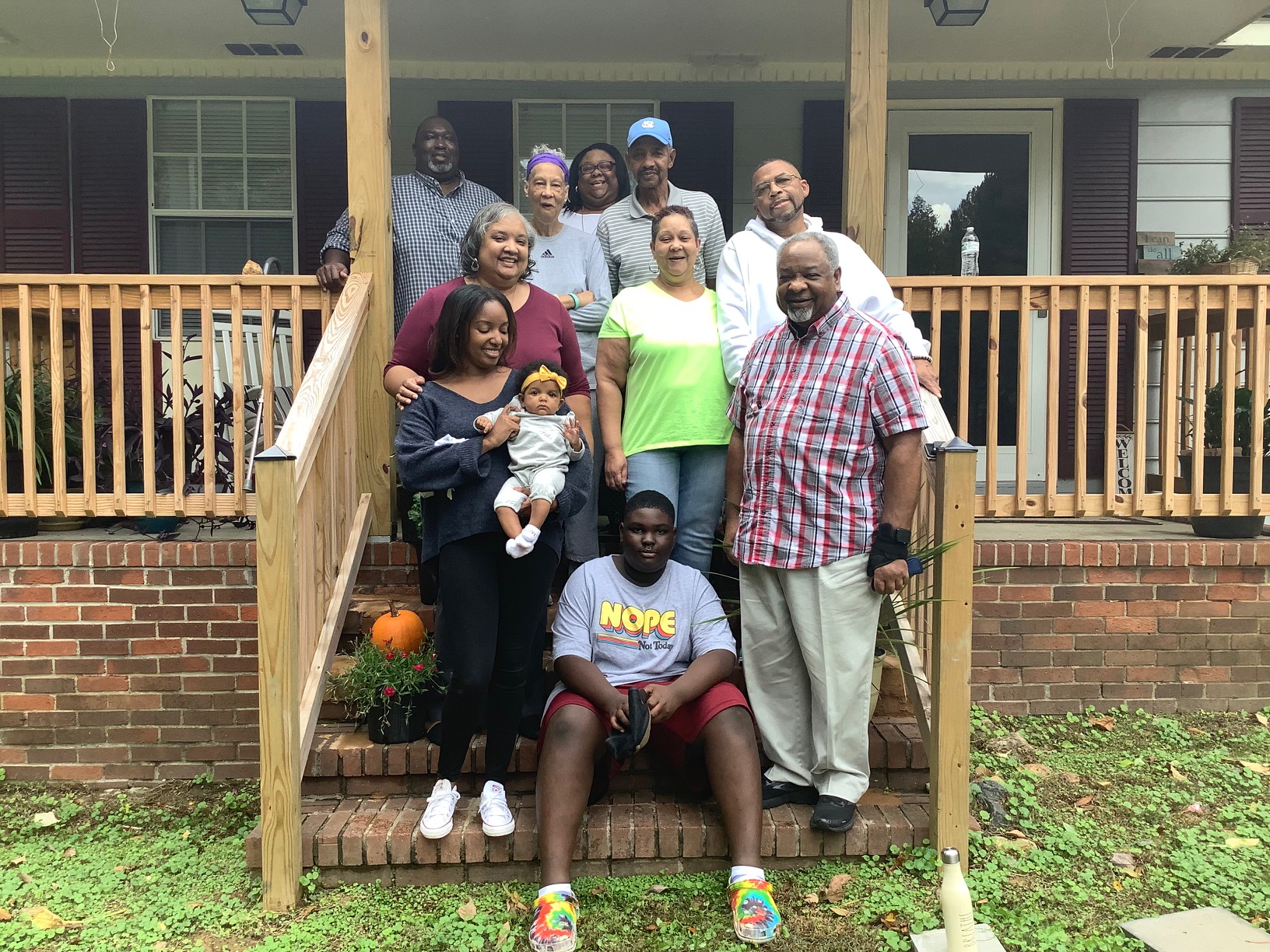
In an effort to get my family more involved in sharing our history, I've invited all of my kin to contribute, as they may desire, to the #52Ancestors posts. Many of my connected family lines don't know each other; and, I believe that this way of sharing our stories and photos could really benefit all of us. I do hope for more participation, but (for now) I am pleased to introduce my second-cousin, Willa-Jo Greene, to my readers. Willa-Jo is the first relative to contribute to these posts, and I'm so excited and grateful! Willa-Jo is sharing this photo, taken in 2015 on the steps of her back deck, at the conclusion of her 50th birthday celebration. Willa-Jo describes this photo as follows: "This photo of my immediate family, 3 nieces, one nephew and three cousins was taken in September 2015 on the back steps of my house in Beltsville MD on the occasion of my 50th birthday."
In this photo: Karen Greene Braithwaite, Diana T Bedden, Georgia M Braithwaite,Avanna D Davenport, Tiberius C Braithwaite, Natalia Sanders Parker, Willa-Jo M Greene, Ava D Greene, William Greene, Renate Yarborough Sanders, George R Greene, Jr.
I will add that the MRCA (most recent common ancestors) for all of us in the photo are our (William, Willa-Jo, Ava, George, Karen, and Renate) great-grandparents, John Wesley Green and Susan Georgiana Dunston. My daughter, Natalia, I descend from their daughter, Anna Beatrice Green; and, the rest of these siblings and first-cousins (and their children) descend from their son, William Lawrence Greene (who added an e to the end of his name).
Thanks, Cousin Willa-Jo, for your contribution! Bravo!
(I have told my family members that they can still send photos after the post has been done, so more may be added after the original posting date.) 😊
Thanks for reading!
Renate
Permalink to this post:https://justthinking130.blogspot.com/2024/01/52ancestors-week-3-favorite-photo.html
This is a quick one, but I just let out the loudest laugh and I want SOMEONE to know why!
I just returned to the recently publicized New York City Historical Vital Records Project, to look for the marriage record of one of my said-to-be-passing, relatives, Ruby Green. I knew that she'd married a man by the surname of SEABROOK, and that he was a doctor, but I hadn't known anything else about him or their marriage.
I easily retrieved the digital record by searching for it by the certificate number, which I already had from an index. I searched first for the marriage in Manhattan, but another couple came up. I changed the search to Kings County, which is Brooklyn, and there there were!
There were a few pieces of information provided on this document that were unknown to me. Some are "a-ha's" and others are just interesting. To maintain the quality of the document, I've cropped the first page (of four) to just show the relevant parts.
Partial clipping of Marriage Record of Ruby Green and Dr. William Seabrook
The A-Ha's
Ruby Green was one of the three people in my Green family who had moved to New York, and were said to be there "passing as white." (The three were Ruby, her sister, Bettie, and their uncle, William A. Green.) I'd been told by relatives who knew her that she was a seamstress on Broadway, who worked for all the "rich and famous movie stars." When I saw on this document that her occupation was "Dressmaking" and that she lived on Broadway, I felt that there may have likely been some truth in the oral history that had been shared with me. (However - and it's a long story - it's said that after William's wife found out that he was black, she outted them all and both Betsie (who was supposedly Doris Duke's hairdresser), and Ruby lost their jobs.
Helpful tidbits to update my tree and help in my research:
1. Ruby's husband's name was William Henry Seabrook. He was a doctor, but I don't think anyone realized he was a veterinarian. The additional information about him and his origins is great.
2. Ruby's middle name was Gordon (if this is real). I hadn't known her to have any middle name, and hadn't seen it on previous records. I thought maybe it was indicative of a previous marriage, but the document states that this is her first. I don't know of any family connection to the name Gordon. Perhaps it has something to do with her (white) father's family. I'll have to check into his family tree.
3. October 14, 1944 - Learning that Ruby didn't marry until 4 years after the death of her uncle, William Adam Green, was helpful to certain aspects of my research. Ruby was the informant on William's death certificate, and I'd wondered why her surname was still Green(e), at that time, because I'd thought by the age Ruby was at that time, she'd have already married. As it is, Ruby was 40 years old when she married William Seabrook.
4. Race - Both Ruby and her husband are noted with "C" for race, indicating that they were colored, or black. According to my now deceased relatives who knew the couple, Dr. Seabrook was dark - or at least brown skinned. He was unmistakably black. New York didn't have any anti-miscegenation laws in place, so if Ruby were passing as white, it wouldn't have been illegal for her to marry a black man; but, being that William Seabrook was from Brooklyn, and likely had family there and was also likely a member of the black elite in the community, it would have been more favorable for Ruby to embrace and enjoy the perks of her blackness in that situation. (It's also likely that the rumors weren't even true. Ruby looked white; she didn't have to try to pass. More likely, she had to work hard to convince people that she was black!)
So, you're probably thinking... "So what was it that had you laughing out loud?"
Well, it was this part of the application.
This part of the document revealed to me that Ruby had, obviously, learned some of the tricky tricks of the passing trade from her Uncle William, before he died. William had a habit of making up names and places, always using a bit of the truth and mixing it with a little flavor to distract anyone from finding out who he really was. That's exactly what Ruby has done here.
Ruby names her father as "John Geene." (That should be Greene.) Well, first of all, the family name was spelled "GREEN," however, Ruby seems to have added the e to the end, as her very accomplished cousin, William Lawrence Greene, had done. That's fine and good. However, John Green, was my great-grandfather, Ruby's uncle - her mother's (and her Uncle William's) oldest sibling. He was not Ruby's father. She is just using his name. From what I've been told, all of Annie Green's (Ruby's mother) children were fathered by Samuel Cannady VANN, a wealthy mill owner, from Franklinton, Franklin County, North Carolina.
Samuel Cannady Vann
(1852-1924)
Next, Ruby takes the liberty of giving her mother, Annie, the surname HAWKINS. This was the last name of Annie's father, Nathaniel, however, he and Annie's mother, Anna, who were my second-great-grandparents, never married. They couldn't have, in North Carolina, even if they'd wanted to. Anna was a mulatto woman and Nathaniel was a white man, from a prominent family in the area. All six of the children they had together carried the surname, GREEN.
So, just to set the record straight for those who are reading this: Ruby's parents were Annie Green and (according to family lore) Samuel C. Vann.
Annie Green (far left) with family members. The two young ladies closest to her are her daughters. One is Ruby, but I don't know which one.
Okay, that wasn't as quick as I thought it would be; but, thanks for reading and allowing me to share this lil chuckle with you.
Renate
Permalink to this post: https://justthinking130.blogspot.com/2022/04/lies-lies-lies.html
As many of my readers know,
I've been researching my YARBOROUGH line for almost 25 years. The targeted
ancestor for this line has been my great-grandfather, Calvin Yarborough, who
was born in or around 1840 and died between 1910-1913. Calvin lived in Louisburg,
North Carolina. He and my great-grandmother, Precilla, were both enslaved.
Together, they had 11 (known) children. To read more about Calvin, click here.
For over 4 years, I have been
giving a presentation called, "Finding Calvin: Following My Enslaved
Ancestor Through Multiple Owners." In this talk, which is actually
a case study, I demonstrate how I determined that Calvin was, indeed, enslaved
and I share the process and methodology used to uncover his ties to four
different enslavers. And, though I hadn't been able to find records leading me
to Calvin's family of origin, which I was sure he'd been separated from, I had
one tiny tidbit of family lore, shared with me by my father's sister, the only
close Yarborough relative still living at the time I began this work. What my
Aunt Sue told me was this: "We
were supposed to be Neals, not Yarboroughs."
Susie Yarborough Hawkins (1920-2013)
Since discovering my
great-grandfather's four enslavers, I've continued the work of researching each
of them, as well as their family members, looking for any information relevant
to Calvin - anything that might lead me to the names of his parents and/or any
siblings. Unfortunately, I came across no revealing records in which family
relationships were noted. So, in the Spring of 2020, bored at home in isolation
because of a global pandemic, I made the decision to plunge more deeply into
working with some of my DNA matches to see if I might be able to figure out how
we are connected. I'd been spending hours and hours in webinars and reading
blog posts about strategies for working with DNA matches, so it was time to up
my game and put some (more) of what I’d been learning into practice.
My first goal was to try to
determine the family line of a set of matches that were matching each other but
were not connecting to any known relatives of mine. The main reason for this
was that these matches were on Ancestry DNA, where the fewest of my relatives had
tested, being that I had obtained most of their samples before 2012, when
Ancestry began implementing autosomal testing. Even for the couple of years
after that, I still mostly used 23&Me and FTDNA for my testing needs, not
knowing that Ancestry would become the “popular choice” and gain such a large
database of testees so quickly. Because of this, though all of my lines are
represented on at least two of the other main sites (to include MyHeritage and
Gedmatch, which allow uploads from the other companies), I am not able to
immediately identify all of my matches on Ancestry by using the Shared Matches
feature on their site. And, since many of these matches have been unresponsive
to messaging and/or unwilling to upload to other sites, I’ve been left with few
other options but to do the work of researching their lines and building out
trees for them, myself. And, so I began, in the Spring of 2020 – and in so
doing, I began to see a common thread in the first few trees I successfully built
out; each of these matches had a NEAL line!
Sanders, Renate Yarborough. “We Were Supposed to be NEALS: Reconstructing an Enslaved Family Using DNA,” Slide No. 31: Accessed 11/1/2021)
As you can see, I was able to
work the trees of these five matches to three Neal ancestors, Wiley
Perry, Lee Ernest, and Louis Napoleon Neal. Thanks to the one person who had a
tree, I learned that the parents of all of these men were James NEAL and
Angeline Jackson. With this revelation, and excited by what it may have meant,
I fervently began reaching out to these matches – and also to many of the
others for whom I’d not yet been able to fully build out a tree. Some responded,
some didn’t. But, regardless, I was able to move forward because of the tree
work I’d done and the research bounty that resulted from it. My initial thought,
that perhaps James Neal was Calvin’s father, was quickly squashed when I
learned that James was born in 1846 – six years after Calvin. Because of the
range in the amount of DNA I was sharing with the 15-20 matches in this group
(at that time), it became clear to me that James was more likely a sibling
of Calvin’s. Realizing that, my next goal became to find out who James’ parents
were – presuming that either one or both of them would be Calvin’s parents,
too.
And so the work continued. I did
find James’ parents – Lewis and Mary Neal – my presumed great-great-grandparents.
I do suspect, though, that perhaps Mary was not Calvin’s mother, because
records are confirming my long-held suspicion that Calvin was separated from
his parents and most immediate family. I will write more about that in a future
post. Nevertheless, until I find differently, I will count both Lewis and Mary
as Calvin’s parents. I’ve also found several other children of Lewis and Mary
Neal – the siblings (half or whole) that were all together with their parents with
their enslaver, John Neal, Jr., son of Calvin’s first owner, Chloe Crudup Perry
Neal, as evidenced by an 1862 inventory, found in John Neal, Jr.’s estate
papers. As a result of this research, I’ve been able to connect with some of
the descendants of Lewis and Mary Neal, and have been in conversation with one,
in particular, my cousin Willard Neal, of Bear Creek, North Carolina. And,
thanks to Cousin Willard, descendants of Lewis and Mary’s once separated offspring –
Calvin and James – were together this past Friday, for the first time, meeting at the home of
Willard’s sister, Jackie, in Pittsboro, NC. That’s right, folks, I met some of
my Neal family, for the very first time! This loving reunion was made even more special
because I was accompanied by my daughter, Natalia, and granddaughter, Teigan.
In all, we represented 4 generations of the descendants of Lewis and Mary Neal! (And I am the furthest generation back of all of us!)
NEAL descendants - Reunited and it feels so good! (Cousin Willard is standing front, right - with the plaid shirt.)
This is just a light summary of the work I did to recover Calvin's family. I tell the entire story, share
my research process, and discuss my hypotheses and theories in my new presentation,
“We Were Supposed to be NEALS; Reconstructing an Enslaved Family Using
DNA,” which debuted this past weekend at the North Carolina
Genealogical Society’s Fall Conference, in Raleigh. That brings me to…
… The second thing:My first in-person presentation, since
February 2020, due to the Covid 19 Global Pandemic!
Here I am, about to speak, at the NCGS Fall Conference 2021. Photo Credit: Connie Knox
Yes, the NCGS Fall Conference was
a hybrid affair, with a cap of 50 people attending in person, joined by approximately
150 online. I was one of the in-person speakers and I have to give KUDOS to the
NCGS team for a perfect setup – and for going over and beyond the requirements for
social distancing. Every effort seems to have been made to make both the participants
and the speakers comfortable with the situation. From the spaced out seating,
adherence to the mask policies, and even the individually wrapped snacks on the
refreshment table – everything was just right. I think this was about building trust
in the organization to do the right thing and, in my opinion, they totally did.
So, thank you to NCGS, an organization that I’m a proud member of, for helping
me to take the first step towards and into “getting back out there” in-person,
to speak.
View of the room from the podium. No one was anywhere near me.
Like I said at the outset, “What
a weekend!” There is so much more to tell. Stay tuned!
Thanks for reading!
Renate
Permalink to this post: https://justthinking130.blogspot.com/2021/11/we-were-supposed-to-be-neals.html
The majority of this post is going to be an update to a previous post, which was written on October 4, 2016, which was 19 years to the day that I'd lost my father. Please click on the links to read more about my dad, from previous posts I've written. Thanks!
Arthur P. Yarborough June 21, 1924 - October 4, 1997
Introducing... Arthur P.
My father, Arthur Person Yarborough, was born June 24, 1924 to parents Anna Beatrice Green and Calvin Yarborough, Jr., in Louisburg, North Carolina. He was the couple's third (and last) child, together, and was named for his father's employer, Arthur Person. Arthur lost his father at the age of 4, to tuberculosis. He spent his early years in the Franklin County School System, but was sent to live with his uncle, during his teen years, and graduated from the Nash County Training School, in 1942.
Nash County Training School, Class of 1942 That's my dad at the top with the open-mouthed smile. :)
"Arthur P.," as he was usually referred to, married a hometown girl, Novella Alston, in 1947. They married in Florence, SC, which I believe must have been where my father was stationed at the time. Most of the details of this marriage are unknown to me, but I'm told that Novella deserted the marriage sometime after my dad adopted my brother, Henry, when they were in Okinawa, Japan. (Or, maybe it was right after they got back to the States.) They were formally divorced in 1958. Sometime in the mid-50's, when my father was in the Hampton Roads area of Virginia, he met a beautiful young divorcee and single mother at the Officers' Club at Fort Story. They quickly fell in love and were soon married, after which Arthur's new bride left her teaching job and home in Virginia to join him in Bremerhaven, Germany. That young lady was my mother, Mary Anne Yarborough, who you can read about, here. Their (eventually tumultuous) marriage lasted 20 years and produced two children, to make a total of four little Yarboroughs.
My dad with his two boys, Edgar and Henry, shortly after marrying my mom.
And then there were six...
23 Years Without My Dad My father has been gone since October 4, 1997 - exactly 23 years, 4 months, and 6 days. I love and miss him, immensely. Before his death in 1997, I’d dibbled and dabbled a bit in genealogy, however, it was when faced with the task of writing my dad’s obituary that I realized how little I knew about him and his life “pre-Renate”, and I certainly didn’t know anything of his family history. And, so it was with his death, and the need to write his obituary, that I consider my real beginning as a genealogy researcher. I started my quest to learn as much as possible about my father , and subsequently my YARBOROUGH ancestry, which was soon followed by all of my other family lines.
That's me with my dad on his 65th birthday.
I Didn't Know...
There was so much I didn’t know about my father before I became a researcher. I didn’t know that about his distinguished military career – about all of the honors and recognitions he’d received, as he worked his way to the rank of Army Major, before he retired in 1964; nor was I aware of the racism he faced while on that journey. I didn’t know anything about the Montford Point Marines, or of the two-plus years my father spent as one of the first to integrate the US Marine Corps, at the beginning of his military service. I'm proud to have received the Congressional Gold Medal, on my father's behalf (posthumously), under the authority of President Barack Obama, in 2015.
Dad, the military man. Date unknown, but early in his career.
I don't know what's going on here, but what I do know is that everyone's attention is on my Daddy!
I didn't know that, before he joined the military, my father spent a year as a student at NC A&T; nor did I know that he continued to complete college coursework while in the Army, excelling in all of his classes, and stopping just short of earning his degree. He also earned a certificate as an Army Surgical Technician!
I think the pic on the left is Marines and I know the one on the right is Army. The bottom shows the medal again, with his Marine and Army dogtags.
I didn't know what a fantastic writer my father was, until I happened upon love letters he'd written to my mother before they were married, and editorials he'd written to an Ohio newspaper, when he was stationed outside of Cleveland (where I was born).
I didn't know that my father had 2 half-sisters and a half-brother, all of whom were deceased before I was born, and that I had a first cousin, born the same year as my dad, who lived in the Bronx and just passed a few years ago. I didn’t know that my father played basketball in high school, and was the quarterback of his football team at Nash County Training School. I didn’t know that the reason my father had to move to Nash County to live with his uncle (the principal of Nash County Training School) was because he was acting up in school, and his mother (widowed since my dad was 4) needed some help with him!
That's my daddy - #10! Where are his kneepads?
These are just a few things I didn't know about my father, but my quest to learn more about him, led to my now 23+ year journey as a genealogist. So, on this day, I choose to remember my father, not with tears, but with a smile. Thank you, Daddy, for inspiring me to do this work. I only wish you were here so I could CELEBRATE all of your magnificent achievements with you, and so that I could ask you the questions I didn't know to ask, and hear some of the stories you probably didn't want to tell when you were here.
This is the house my dad where my dad grew up, in Louisburg, NC, known (affectionately) to me as "Grandma's House." The house, which is still in the family, was built by my grandfather, Calvin Yarborough, Jr. and his brother, Samuel Yarborough, in 1911.
These are the only pictures I've ever seen of my father as a boy. To the left, you can partially see one of his first cousins, George R. Greene, whose family my dad lived with, during his teenaged years. To the right, there he is will all three of his cousins - George, John, and Rolland Greene. Because of my father living with them, their relationship with him was like a brother, not a cousin. They are all in heaven, now.
My father absolutely loved being a "Grandpa." Here, he's with my oldest daughter, Natasha, who was born on his 58th birthday!
He had at total of 8 grandchildren, and he loved them all; and he now has 5 great-grandchildren, and one on the way!
My dad LOVED family (just as I do). Though he never returned to Louisburg to live, he (we) always went back to visit his beloved family. Sadly, I don't seem to have any photos of my dad with his mother, but here is a photo of him with his siblings on one of his (many) visits home.
The Yarborough siblings - they were so close. Arthur, Susie, and Calvin III
This photo shows my dad on a visit to Louisburg, with some of his favorite family members. In front are my two daughters. L-R, his sister, Susie, my dad, me, his cousin, John Greene, John's wife, Nellie, my dad's first cousin, Geral Yarboro Sargent, and his brother, Calvin III.
My dad with his cousin Geral and an unknown relative
Dad with my Aunt Ruby, my Uncle George's wife
At the first of only two (ever) Yarborough Family Reunions 1993 in Baltimore. Seated: Cousin Geral and Cousin Madie Standing: My dad (Arthur), Cousin Ralph, and Uncle Calvin (my dad's brother)
I gave this shirt to my dad for Father's Day, one year, and he LOVED it. The pictures are of my two daughters. I think it said, "We love you, Grandpa!"
I love and miss you, Daddy!
Thanks for reading!
Renate
Permalink to this post: https://justthinking130.blogspot.com/2021/02/my-black-history-2-my-daddy-arthur-p.html
*All photos are the property of the author of this blog, and should not be used, saved, or copied without my explicit permission. Thank you.
I am a DUNSTON descendant. This is not a line I knew anything about, before I started my research in the 1990s. My grandmother, Anna Green, was the daughter of Susan Georgiana DUNSTON, who married John Wesley Green. That is where my Dunston line begins.
(As is the case with most of my lines, I have no photo to show of my great-grandmother, so I will just use this clipping from Ancestry to represent her.)
Researching the DUNSTONS
My Dunston line has been tricky to research, but I've done so with extreme care for over 20 years, now. What makes it trickiest is the fact that so many of the names are used over and over, sometimes within the same generation, and many of those names are common ones, like James, John, Anna/Annie and Laura. Because of this, I've been extremely careful about who actually gets a spot on the tree. I must be able to prove, with documents, that I have the right people in the right place - at least to the best of my ability. Anyone I'm unsure about either has a research note added to their profile on my tree, or they don't make it onto the tree, at all, but instead earn a place in my Ancestry "Shoebox," until such time that I can find definitive evidence that they actually belong to me.
Over the years, I've communicated with many Dunston descendants, all of whom have an ancestral connection to the area of North Carolina where my Dunstons are from: Franklin County. For some, the connection to this county is immediate, and for others it takes a few generations into their ancestry to get back there. Branches have conglomerated in nearby Wake (Raleigh) and Vance (Henderson) Counties, as well as a very large contingent, which migrated to Philadelphia, Pennsylvania in the early part of the 20th century. And, quite a few of the Dunstons remained in Franklin County, mostly in the town of Franklinton, but with a few families in the county seat, Louisburg. (The Pennsylvania group originated in Franklinton.)
Through my research and also as a result of interactions with others in the genealogy community, I've met numerous Dunston descendants, who hail from various of the above-mentioned locations. Most of us were told, once upon a time, that all of the Dunstons from Franklin County were related. But, proving that has been a challenge, as we've worked collegially to try to explore how we might be - must be connected. In some cases, we've been successful, but the MRCA (most recent common ancestor) is so many generations back that we are not sharing any DNA to prove it. Therefore, we must rely on our carefully constructed family trees for documentation of our connections. And, in a few cases, we are not seeing any matchups on our trees, so we continue to wait, hoping one day a relationship may show us to be connected, but, if it doesn't, we continue to support each other's research and say that we are "cousins" anyway. :)
My Dunston Line
My own DUNSTON line goes back 9 generations (yes, NINE!) to my sixth great-grandmother, Patience Dunston, who was born in 1734. I first learned of Patience through the work of Paul Heinegg, the award-winning author of Free African Americans of Virginia, North Carolina, South Carolina, Maryland, and Delaware. My direct line (below) is well documented from Patience, all the way down to me. I continuously search for, find, and add additional sources that support my findings - or, if they don't, changes are made.
Troubled Waters
There is one line of my Dunston family that refuses to acknowledge their connection to me, simply because "they don't have those names." This is the branch that moved to Philadelphia, which is a line that descends from my third great-grandfather, Wilson Dunston (Sr.). This line, which descends from Wilson's son, James "Jim" Wilson Dunston, is documented on my tree and has come up as the connector between several of my DNA matches and me, as well as for people whose trees reflect that connection, just as mine does. There is just one problem though: it seems that the Philadelphia line, which boasts of having at least 3 family historians, has only been documented up to the generation that includes James "Jim" Dunston. Because they are unaware (apparently) of James' parentage or deeper ancestry, they choose to denounce it or to even acknowledge and/or learn about his familial origins. So... Houston, we have a problem.
This photo was shared with me by the one Philadelphia Dunston cousin who believed and allowed me to share my research findings - the late Karen Serene Dunston. May she rest in peace.
On the left is James Wilson Dunston, who was the son of my third great-grandfather, Wilson Dunston. He was the great-grandfather of the cousin denoted by the green dot, above.
On the right is his wife, Harriet Ellen Fields.
This chart, created using my tree on Ancestry dot com, shows the relationship of one of the Philadelphia-born Dunston cousins and myself. (Said cousin is represented by the green dot.) The relationship, based on the sourced and documented work I've done on my tree, is undeniable. However, because this family has never heard of our common ancestor, Wilson Dunston, he, to them, does not exist; and therefore, we are not related. This stance has been taken by three different members of this particular family, over the course of a few years. I'm not going into the particulars about the difficult attempts I've made to communicate with them - even, most recently, as a result of this cousin reaching out to me - not vice versa. I understand that not everyone understands this work that we're doing; but I'm not in this to be mistreated, talked down to, dismissed and/or disrespected. I simply want to find and learn about my Ancestors, and sometimes that means encountering people who are unexpectedly (and unabashedly) ____________. (You fill in the blank.)
Concluding with Gratitude
I'm very thankful that what I've experienced in dealing with this family line has not been the norm during my 23 years of formally researching my ancestry. I've met so many relatives, on several different lines, and these are the only ones that have behaved in this way and not wanted to know or discuss anything about our shared ancestry. This Dunston line, for whatever their reasons, chooses to stay in the dark about their own pedigree. That has nothing to do with me. I thank God for the Hills, the Rosses, Yarboroughs, Davenports, the Tredwell/Littlejohndescendants, and several other cousin connections I've made over the years - some due to the blessing of good solid traditional research, and others thanks to irrefutable DNA evidence (which doesn't lie).
I was told that this is my second great-grandmother, Laura Dunston, who was a Dunston already before she and Wilson "Wils" Dunston married. This is the only known photo I have of one of my direct Dunston ancestors.
Walk in the Light - Beautiful Light!
Today was a slap in the face; but it will take more than this to stop me from my quest to find my ancestors and to connect with those who share them. I started this journey to find out who I am and what I'm made of. Like Joe Biden, the Democratic candidate for President of the United States said in his nomination acceptance speech, as he quoted my (Ross descended) cousin, Ella Josephine Baker: "Give people light and they will find a way." And, like Joe, and like Ella, I choose to follow the light. Why? Because, just as Joe said, "Light is more powerful than darkness."
If any of my Philadelphia Dunstons happen to read this, know that I love you, because you are my family. If you want to reach out to me, I'll be ready to share and move forward; and, just as I've told the three that I've spoken to, if you have evidence that is contrary to what my research has shown, I am open and willing to hear and consider it.
I needed to vent.
Thanks for reading.
Renate
(I do not own the rights to this music.)
Permalink to this post: https://justthinking130.blogspot.com/2020/08/yes-philadelphia-dunstons-we-are-related.html
A couple of nights ago, I took a look at the FamilySearch catalog to see if there were any online entries for Louisburg, NC that I hadn't already read, but wanted to. I decided to look at the digitized records for St. Paul's Episcopal Church, which cover the years 1845 to 1964. I knew that some of my European ancestors were connected to this church, so I thought I'd take a peek to see if any of them were mentioned. They were, but from the very beginning I realized that this document was going to be lucrative for me in ways I hadn't imagined; even then, I had no idea of the genealogical loot I was about to collect.
The first thing that raised my interest was seeing the name of my great-grandfather, Calvin Yarborough’s last owner, James H. Yarborough, on the pages before me. It seemed that he was greatly involved in the church - a fact that was soon explained by documents naming him as part of the church’s Vestry. Not only was James quite active in the church, but his second wife, Arete, who would become Calvin's final owner (after James' death), and her father, Dr. Wood T. Johnson, and sister, Otelia, were, too.
This is a photo of my great-grandfather's third owner, James H.Yarborough.
James H. Yarborough was (re)appointed to the vestry on Easter Monday, 1960. He died later that same year. (The check marks indicate names of other vestry members who were connected to my family one way or another.)
I decided to commit to reading through the entire 522 images in this record set (two pages per image, in most cases) when I realized its scope. Not only would I be reading about church business, such as assignments of rectors, financial giving, appointments of vestry members, etc., but in what seemed like a (genealogist's) dream, births, deaths, and marriages were annotated, as were baptismal records and information about burial locations.
This excerpt from the marriage records notates the nuptials of my great-grandfather’s second owner, Elizabeth Temperance (“Tempie”) Neal to his third owner, James H. Yarborough on November 29, 1853.
There was also a section showing purchases of cemetery plots, with complete descriptions of each plot and its location! This is a goldmine of information, and I suggest that anyone with ties to Louisburg/Franklin County take the time to browse these amazing records. But, for me, the real treasures came in finding that these records also included tons of information about African Americans in the community, the greatest of which was related to formerly-enslaved individuals (with family data included), but some of which was regarding post-Reconstruction interactions with blacks in the community. Here is just a sampling of the goodies:
Infant Baptisms
This is one page of many which gives details about infant baptisms. What struck me is that, on most pages, the baptisms of "servants" were intertwined with those of the regular parishioners, just as seen here. They were not separated by race. This was also true of the adult baptisms, deaths, and other records. Notice that the names of the parents are given with those of the enslaved infants.
Dr. Wood T. Johnson was a member of the Vestry and was, by far, the most active parishioner in getting his enslaved servants baptized. He was also the father of my great-grandfather, Calvin's last owner - his daughter, Areta E. Johnson Yarborough, also an active member of this church.
Burials
This next document shows burials that were recorded in the church records. The blue circles indicate members of my great-grandfather's enslaver's family. None of this was new information, but it was fulfilling to see it confirmed in another context.
Richard Fenner Yarborough was the father of James H. Yarborough, my great-grandfather's third owner. Elizabeth Temperance (Neal) Yarborough was James H. Yarborough's wife. She was Calvin's second owner, having acquired him following the death of her mother. Herbert Yarborough was James and Elizabeth's only child. He died shortly after his mother when he was just a few months old.
This brings me to what was one of the most fascinating (and completely unexpected) finds in this entire record set. Recently, I've discovered that I have a direct ancestral connection to Somerset Place, the large Washington County, NC plantation, originally owned by several generations of the Collins family, which I just visited on a "field trip" with my AAHGS chapter, in June. (You can read about my visit to Somerset, here.)
Three generations of my mother's paternal grandmother's line were enslaved at Somerset, with my great-grandmother, Pinkey Tredwell, actually being born on the plantation. Pinkey, along with her parents, Mack Tredwell and Amy Littlejohn, were among the almost 300 enslaved who were transferred by owner, Josiah Collins III, to Franklin County during the Civil War. There, he established a plantation called "Hurry Scurry", where the conglomerate would remain until after the war's end.
It is written that Josiah III was a dedicated Episcopalian and that it was important to him for his human chattel to be trained in the teachings of this faith. At Somerset, he'd hired someone to "convert” his enslaved population "from Methodism to the Episcopal Church", He also employed a private chaplain, George Patterson, to perform religious services on the plantation. Apparently, Collins III must've connected himself, immediately, with the Episcopal church in Louisburg upon his arrival in the area. The documents below show submissions of many deaths among the enslaved at Hurry Scurry, some of which are known or suspected family members of mine.
This page includes the death and burial information for 20 of Hurry Scurry's enslaved. The blue dots indicate known and/or suspected members of my family. (The Mack and Amy are not my second gg-parents, but I believe they may have been two of their children.) Notice the name of the officiating clergyman for the majority of the burials: George Patterson, who was the same person Josiah Collins III had hired as his chaplain back at Somerset.
On this next page, 4 more burials of Hurry Scurry’s enslaved population are recorded. Notice their owner is now Mrs. Josiah Collins. Josiah III died, in 1863, at another of his plantations, in Hillborough. This is the same year as the bulk of the entries on the previous page. Presumably, sickness or disease must’ve struck Hurry Scurry in 1863.
Church Business
Of course, this record includes a compilation of church business – namely minutes from meetings of all types, with the bulk being meetings of the vestry. Admittedly, as I got past the first years of the 20th century, my interest in the subject matter began to wane, and I found myself scanning, rather than actually continuing to read the documents word for word. Still, some items of interest were found:
No More Blacks in the Church
This resolution was proposed and unanimously approved by the members of the vestry on July 17, 1891. It reads as follows:
“A resolution was offered and adopted directing the Secretary to advise the Rev. Wm. Walker, Archdeacon of the colored work in this diocese, that the use of St. Paul’s church is hereafter forbidden for his services for the colored people in the town.”
More Burial-Related Notes
Left: September 19, 1857, Mr. J. B. Yarborough requests permission to bury his child in the enclosure around the church.
Right: October 24, 1857, a resolution is passed preventing the churchyard from continuing to be used as a burying ground.
Building Fund
In this accounting of the Building Fund from December 1900 my grandfather's brother, H.K. (Henry King) Yarborough is noted to have been paid for "putting brick underpinning of old ch(urch)". If I'd not already known of my grand-uncle's occupation as a brick mason, this would have been a helpful clue to follow up on.
Closing
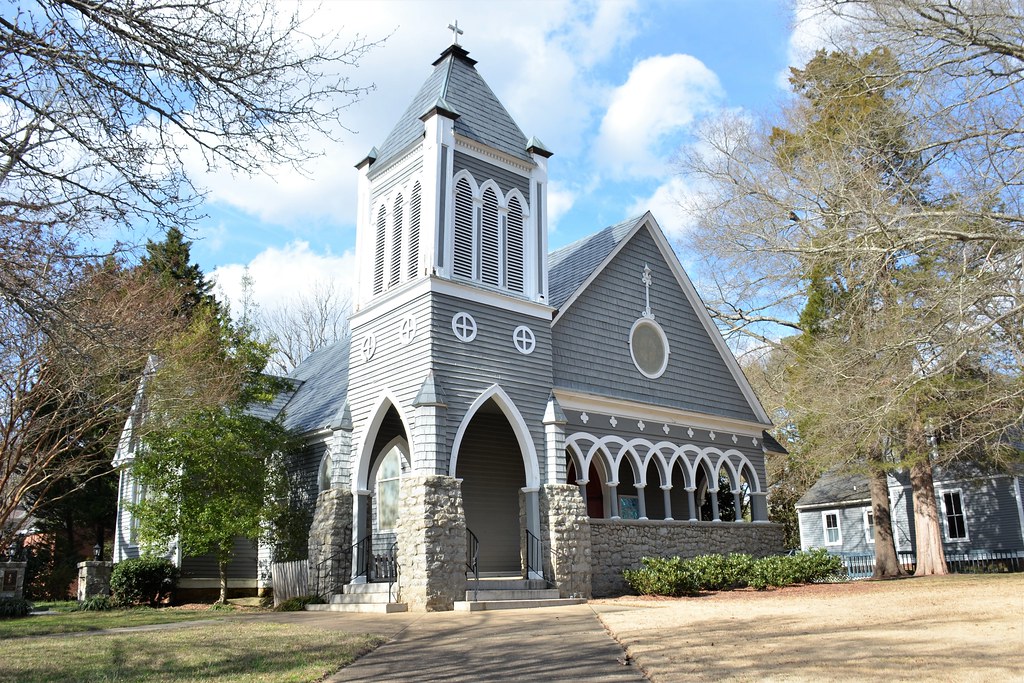
There are two "coincidences", of sorts, that I want to mention before I close. The first is just that, in my frequent trips to Louisburg, one of the things I most enjoy doing is riding around the north end of town, where the grand old homes of the town's former white "elite" still stand - including the homes of my ancestors' owners. I've also been able to identify properties to which I have a direct ancestral connection but, mostly, I just enjoy looking at all of the fabulous (and very large) architecture, imagining who had lived in each home, and thinking about all that I know about Louisburg in the time period that most of the homes were built. In addition to my love of these homes, I also routinely stop and admire the churches, taking photos of them and observing the uniqueness of each edifice's architecture. Coincidentally, one of the most interesting structures, to me, has always been the St. Paul's Episcopal Church, located on an unassuming corner of Church Street, a block away from Louisburg College and right smack in the middle of a residential neighborhood, just two blocks up from the homes of my second and third great-grandparents, Nathaniel M. Hawkins and his parents, Philemon and Jacobina Hawkins. (They were not members of the Episcopal Church.)
The second rather interesting coincidence is that as I was wrapping up this post I was watching the very Episcopal funeral service for former President George H.W. Bush. It made it very easy for me to imagine what services may have been like inside this church - the St. Paul's Episcopal Church of Louisburg, North Carolina.
Church records have long been known to be excellent sources of genealogical information and have been used by researchers for eons. However, for me, this is the first time I’ve gleaned this much useful information from them and I’m exhilarated! I have studied the available records for many of the churches I’ve known my ancestors to have belonged to, but have previously disregarded those of other nearby churches. I’ve learned a great lesson from this and, going forward, will check out any church records made available from the counties and towns that I research.
For more information about researching church records for genealogy, here's a link to an excellent article from Family Tree magazine.
Thanks for reading! I hope others will be helped by what's been shared here. I welcome your comments and would love to hear about how researching church records may have helped you!
NorthCarolinahistory.org: An Online Encyclopedia, “Josiah Collins III (1808 - 1863)” (by Matthew Shaeffer), http://northcarolinahistory.org (accessed December 5, 2018).
https://www.familytreemagazine.com/premium/church-records-genealogy-workbook/ (Accessed December 5, 2018)