Facebook

Showing posts with label Somerset. Show all posts

Sunday, January 5, 2025

A New Marriage for Grandpa Daniel Hill

Well, blow-me-down! Will wonders never cease?

I was just sitting here minding my own business, kinda bored... I opened an ancestry tab on my computer and saw that it was on the profile of my maternal grandfather, Daniel Webster Hill. Just for the heck of it, I decided to do a search to see if there might be anything new on him. I scrolled down the list of results, seeing all the old familiar ones that I've long since vetted, when one "newbie" caught my eye. Hmm... a marriage of a Daniel Hill to a Lizzie Campbell, in 1918, in Newport News, VA.

NEWPORT NEWS, VA? That's where I live! 

I could see from the preview that this Daniel's birthyear closely matched my grandfather's. I also saw that his parents were Henry and Pinkie - too much of a coincidence to ignore... so I decided to check out the document. 


Virginia, Marriage Registers, 1853–1935. Library of Virginia, Richmond, Virginia.

Now, I like to show the whole document, for viewer context, but here are the focal points:

The very first entry on the document shows the marriage of Daniel Hill and Lizzie Campbell, recorded as having taken place on April 21, 1918, in Newport News. Daniel's age is given as 38, which coincides perfectly with his birth year of 1879. His bride, Lizzie, was 32. Daniel is noted to be "single," but Lizzie is widowed, suggesting that Campbell may not be her maiden name. Daniel's birthplace is given as Norfolk, which is not correct; however, he did live in Norfolk, prior to this, so I see this as just a form error.

This is the right-hand side of the form. It's showing that both Daniel and Lizzie lived in Newport News. What??? My grandfather lived here in my city??? I've got some digging to do! But, the real clincher for this - the reason I'm sure this is my grandfather - is the "names of their parents." The husband's parents' names are stated to be Henry & Pinkey Hill. Well, those are Daniel's parents, and I just don't think it's likely that, with all the other facts matching, there would be a "Pinkey" for the mother, whose husband just happened to be named Henry, and it not be my Daniel. Also, as suspected, the wife's parents' surname is Christian, not Campbell. This suggests that Lizzie's maiden name was most likely Christian, and that Campbell was the surname of her late, previous husband.

So many questions!

Well, I've got some work to do! Daniel's occupation is noted to be "Laborer," which could be anything. However, with so many people coming to Newport News, during that time, to work at the shipyard, my first thought is to see if he may have been working there. I'll also have to research the clergyman, W.J. Brown, to see what church he may have been affiliated with, which might lead to more information. And, of course, I'll need to try to obtain a copy of the actual marriage certificate, which as of this writing, I haven't found. However, in seeking the marriage certificate, I did find that Grandpa Daniel's first bride, Lizzie, died just four years after they were married, in 1922, which explains why Daniel was eligible to marry my grandmother, in 1926. Interestingly, Lizzie's surname on the death certificate is given as "Camble" (Campbell), not Hill. The parents of the deceased, Warren and Mary Christian, are the same as on the marriage record for Lizzie and Daniel, so I'm sure this is her. This just fits the pattern of craziness that has been par for the course in researching my elusive grandfather, Daniel Webster Hill.

Death Certificate for Lizzie Camble
Virginia, Deaths, 1912–2014. Virginia Department of Health, Richmond, Virginia.

More to come...

Renate

Permalink to this post: https://justthinking130.blogspot.com/2025/01/a-new-marriage-for-daniel-hill.html


Tuesday, December 3, 2019

More Questions Than Answers - My Grandfather's Social Security Application

Temporary Joy?
Today, I received a copy of the Social Security Application for my maternal grandfather, Daniel Webster Hill. I was so excited when I got the envelope from my mailbox, especially since I'd kind of forgotten I'd ordered this document. Daniel's life, as well as that of his mother and full siblings, has been challenging to document, either because of conflicting or absence of information.
1937 Social Security Application for Daniel Webster Hill
My hope, when I ordered this document was that it would provide conclusive data, so I was quite excited as I carefully tore open the envelope. Instead, its contents have led me to more questions as I try to uncover the true facts of my grandfather's life.

Dissecting the Document


Out of this entire document, only two items bore no concern; my grandfather's gender (male) and race (Negro). Everything else either provided confirmation of my research or conflicted with previous findings, thus inciting further questions that will need to be answered.

Name (Red):Thankfully, this document confirms my grandfather's full name: Daniel Webster HILL.

Address (Purple and Brown): This was the first issue on the document. The address given is not the address of the home in which my grandparents lived while they were together. Family lore has always been that my grandfather left (abandoned) the family when my mother was 4 and her brother was 7. That would have been sometime between September 10, 1938 and March 23, 1939. However, this application is dated February 25, 1937, which precedes that date range by over a year and a half, making my mother not even 3, yet, and her brother, only 5. The only thing I can think is that perhaps he came back after this date, before leaving for good.
BUT.... there's another thing these two items actually corroborate for me! My late uncle, Howell Hill, who I interviewed numerous times about his and my mother's family and ancestry, told me something I haven't forgotten. In describing what he recalls as a domestic abuse situation between Daniel and my grandmother, Mary, my uncle told me how when Daniel Hill first left them, he just moved into a room in the house next door, and they would see him watching them from an upstairs window. He expressed how afraid this made him, because Daniel Hill "was so mean". Well, I used google maps to look up the address on the SS application, and, lo and behold, 1301 W. 42(nd) St. is right next door (though across a small street) to my grandmother's house, 1273 W. 42nd Street.

In this current-day photo from Google Maps, the house on the left (1273) is the house my mother grew up in. The house on the right (1301) is the house Daniel Hill was living in at the time he filled out his Social Security application. Notice the upstairs side windows on this house, which directly face my grandmother's home, making my uncle's story seem quite likely to be true.

Employment (Yellow/Blue): In 1930, according to the Census, my grandfather was working as a Longshoreman at the Pier (usually meaning Lambert's Point). However, at the time of his SSA, he states that he's unemployed. Could this have been part of the issue that played into the problems he and my grandmother were (apparently) having? Also, Item 13 indicates that Daniel was registered as an employee with the W.P.A., something I wasn't aware of and will need to research further.

Age (Orange): Daniel Hill's true birth year has been an issue since I began researching him, many years ago. It seems that he began using this 1885 birth year around the time he married my grandmother. He was much older than she, so perhaps this was his way of smoothing that out. I really don't know. But, Daniel shows as a one-year-old in the household of his parents in 1880 and, in 1900, he is a boarder in the home of his mother and stepfather, enumerated as 20 years old with a birthdate given as March 1879. It's not until after his 1926 marriage to my grandmother that I first see him being referred to as a younger man -- with his age being enumerated in 1930 as 40, with whoever gave the information stating that he'd been 36 at the time of his first marriage. From this point on, any documents I've found on Daniel Hill give him this younger age.


1880 Census showing one-year-old Daniel W. in the household with his parents and sisters, in Tyrrell County NC. Birthplace is given as North Carolina for the entire family.
Place of Birth (White): I have seen Daniel's place of birth given as Virginia on other documents, but I'm confused about that, since I know the family (both his mother and father) were from North Carolina, and he is enumerated with them, at just one year old, in that state. However, I guess it is possible that his mother could have been in Virginia (for some reason) when he was born, though I really doubt it. He lists "Gilmerton, Norfolk Co., VA" as his birthplace on this application. This is, indeed, where his mother, Pinkey, later lived and ran a boarding house with his stepfather, and where, according to the newspaper announcement of her death, she was buried, but she doesn't appear there before 1900. Perhaps she was visiting a family member at the time of his birth, just as she was at the time of her death? This will require further research.

Death notice from Norfolk, VA Journal and Guide, announcing the death of Pinkie (Hill) Howell

Parents' Names (Green/Pink) - Daniel confirms his parent's names. but with exceptions. His father was known as "Henry" Hill, but his full name was actually Charles Henry Hill. (I think it's quite possible that Daniel may not have known that.) His mother, Pinkie's, maiden name has been another source of confusion. She'd been enslaved on Somerset Plantation, in Creswell, NC, which was owned by the COLLINS family. Her father was Mack TREDWELL, but sometime prior to Emancipation, her mother married a man named Peter KING. Pinkie has been recorded as using each of those surnames on different documents, so it's hard to know which (if either) was actually her "legal" maiden name. It does seem clear, though, that she considered Peter King to be her father figure and that seems to be what Daniel understood, also, according to this document.

Social Security Applications are typically very useful documents for genealogists; however, as this one shows, sometimes that usefulness can provide a mixture of evidence-types for the researcher: direct and indirect, consistent or conflicting, and, sometimes, negative or even absent. A careful researcher will study all of the information on a document, analyzing each item and following up with further research to work towards solving conflicts and/or filling in blanks. This SSA for my grandfather, Daniel W. Hill certainly is leaving me with more work to do, but I am up to and looking forward to the challenge!

Thanks for reading,
Renate

Sources:
 United States Social Security Application, Form SS-5, Treasury Department, Internal Revenue Service: Daniel Webster Hill, February 25, 1937.

United States Federal Census, Year: 1880; Census Place: Scuppernong, Tyrrell, North Carolina; Roll: 983; Family History Film: 1254983; Page: 269D; Enumeration District: 134; Image: 0453.

New Journal and Guide (1916-2003); June 1, 1929; ProQuest Historical Newspapers: Norfolk Journal and Guide, p. 4

Link to Google Maps:


Permalink to this post:
https://justthinking130.blogspot.com/2019/12/more-questions-than-answers-my.html


Wednesday, December 5, 2018

Church Records for Genealogical Research - What a Find!

A couple of nights ago, I took a look at the FamilySearch catalog to see if there were any online entries for Louisburg, NC that I hadn't already read, but wanted to. I decided to look at the digitized records for St. Paul's Episcopal Church, which cover the years 1845 to 1964. I knew that some of my European ancestors were connected to this church, so I thought I'd take a peek to see if any of them were mentioned. They were, but from the very beginning I realized that this document was going to be lucrative for me in ways I hadn't imagined; even then, I had no idea of the genealogical loot I was about to collect.

The first thing that raised my interest was seeing the name of my great-grandfather, Calvin Yarborough’s last owner, James H. Yarborough, on the pages before me. It seemed that he was greatly involved in the church - a fact that was soon explained by documents naming him as part of the church’s Vestry. Not only was James quite active in the church, but his second wife, Arete, who would become Calvin's final owner (after James' death), and her father, Dr. Wood T. Johnson, and sister, Otelia, were, too.
      
This is a photo of my great-grandfather's third owner, James H.Yarborough.

James H. Yarborough was (re)appointed to the vestry on Easter Monday, 1960. He died later that same year. (The check marks indicate names of other vestry members who were connected to my family one way or another.)


I decided to commit to reading through the entire 522 images in this record set (two pages per image, in most cases) when I realized its scope. Not only would I be reading about church business, such as assignments of rectors, financial giving, appointments of vestry members, etc., but in what seemed like a (genealogist's) dream, births, deaths, and marriages were annotated, as were baptismal records and information about burial locations
This excerpt from the marriage records notates the nuptials of my great-grandfather’s second owner, Elizabeth Temperance (“Tempie”) Neal to his third owner, James H. Yarborough on November 29, 1853.

There was also a section showing purchases of cemetery plots, with complete descriptions of each plot and its location! This is a goldmine of information, and I suggest that anyone with ties to Louisburg/Franklin County take the time to browse these amazing records. But, for me, the real treasures came in finding that these records also included tons of information about African Americans in the community, the greatest of which was related to formerly-enslaved individuals (with family data included), but some of which was regarding post-Reconstruction interactions with blacks in the community. Here is just a sampling of the goodies:

Infant Baptisms
This is one page of many which gives details about infant baptisms. What struck me is that, on most pages, the baptisms of "servants" were intertwined with those of the regular parishioners, just as seen here. They were not separated by race. This was also true of the adult baptisms, deaths, and other records. Notice that the names of the parents are given with those of the enslaved infants.


Dr. Wood T. Johnson was a member of the Vestry and was, by far, the most active parishioner in getting his enslaved servants baptized. He was also the father of my great-grandfather, Calvin's last owner - his daughter, Areta E. Johnson Yarborough, also an active member of this church.

Burials
This next document shows burials that were recorded in the church records. The blue circles indicate members of my great-grandfather's enslaver's family. None of this was new information, but it was fulfilling to see it confirmed in another context.
Richard Fenner Yarborough was the father of James H. Yarborough, my great-grandfather's third owner. Elizabeth Temperance (Neal) Yarborough was James H. Yarborough's wife. She was Calvin's second owner, having acquired him following the death of her mother. 
Herbert Yarborough was James and Elizabeth's only child. He died shortly after his mother when he was just a few months old. 

This brings me to what was one of the most fascinating (and completely unexpected) finds in this entire record set. Recently, I've discovered that I have a direct ancestral connection to Somerset Place, the large Washington County, NC plantation, originally owned by several generations of the Collins family, which I just visited on a "field trip" with my AAHGS chapter, in June. (You can read about my visit to Somerset, here.)

Three generations of my mother's paternal grandmother's line were enslaved at Somerset, with my great-grandmother, Pinkey Tredwell, actually being born on the plantation. Pinkey, along with her parents, Mack Tredwell and Amy Littlejohn, were among the almost 300 enslaved who were transferred by owner, Josiah Collins III, to Franklin County during the Civil War. There, he established a plantation called "Hurry Scurry", where the conglomerate would remain until after the war's end.

It is written that Josiah III was a dedicated Episcopalian and that it was important to him for his human chattel to be trained in the teachings of this faith. At Somerset, he'd hired someone to "convert” his enslaved population "from Methodism to the Episcopal Church", He also employed a private chaplain, George Patterson, to perform religious services on the plantation. Apparently, Collins III must've connected himself, immediately, with the Episcopal church in Louisburg upon his arrival in the area. The documents below show submissions of many deaths among the enslaved at Hurry Scurry, some of which are known or suspected family members of mine.


This page includes the death and burial information for 20 of Hurry Scurry's enslaved. The blue dots indicate known and/or suspected members of my family. (The Mack and Amy are not my second gg-parents, but I believe they may have been two of their children.) Notice the name of the officiating clergyman for the majority of the burials: George Patterson, who was the same person Josiah Collins III had hired as his chaplain back at Somerset.


On this next page, 4 more burials of Hurry Scurry’s enslaved population are recorded. Notice their owner is now Mrs. Josiah Collins. Josiah III died, in 1863, at another of his plantations, in Hillborough.  This is the same year as the bulk of the entries on the previous page. Presumably, sickness or disease must’ve struck Hurry Scurry in 1863.

Church Business
Of course, this record includes a compilation of church business – namely minutes from meetings of all types, with the bulk being meetings of the vestry. Admittedly, as I got past the first years of the 20th century, my interest in the subject matter began to wane, and I found myself scanning, rather than actually continuing to read the documents word for word. Still, some items of interest were found:

No More Blacks in the Church


This resolution was proposed and unanimously approved by the members of the vestry on July 17, 1891. It reads as follows:
“A resolution was offered and adopted directing the Secretary to advise the Rev. Wm. Walker, Archdeacon of the colored work in this diocese, that the use of St. Paul’s church is hereafter forbidden for his services for the colored people in the town.”


More Burial-Related Notes
Left: September 19, 1857, Mr. J. B. Yarborough requests permission to bury his child in the enclosure around the church.
Right: October 24, 1857, a resolution is passed preventing the churchyard from continuing to be used as a burying ground.

Building Fund 

In this accounting of the Building Fund from December 1900 my grandfather's brother, H.K. (Henry King) Yarborough is noted to have been paid for "putting brick underpinning of old ch(urch)". If I'd not already known of my grand-uncle's occupation as a brick mason, this would have been a helpful clue to follow up on.

Closing
There are two "coincidences", of sorts, that I want to mention before I close. The first is just that, in my frequent trips to Louisburg, one of the things I most enjoy doing is riding around the north end of town, where the grand old homes of the town's former white "elite" still stand - including the homes of my ancestors' owners. I've also been able to identify properties to which I have a direct ancestral connection but, mostly, I just enjoy looking at all of the fabulous (and very large) architecture, imagining who had lived in each home, and thinking about all that I know about Louisburg in the time period that most of the homes were built. In addition to my love of these homes, I also routinely stop and admire the churches, taking photos of them and observing the uniqueness of each edifice's architecture. Coincidentally, one of the most interesting structures, to me, has always been the St. Paul's Episcopal Church, located on an unassuming corner of Church Street, a block away from Louisburg College and right smack in the middle of a residential neighborhood, just two blocks up from the homes of my second and third great-grandparents, Nathaniel M. Hawkins and his parents, Philemon and Jacobina Hawkins. (They were not members of the Episcopal Church.)


                                           Image result for st paul's episcopal church louisburg


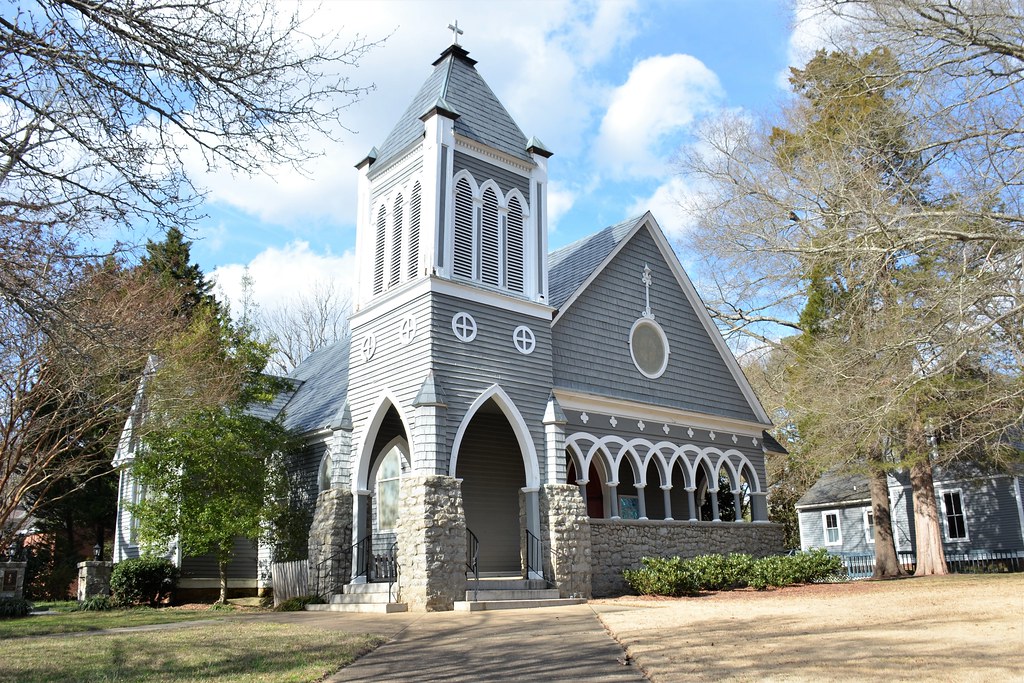
St. Paul's Episcopal Church, Louisburg, NC
(Photo by E.C. Leatherberry)

The second rather interesting coincidence is that as I was wrapping up this post I was watching the very Episcopal funeral service for former President George H.W. Bush. It made it very easy for me to imagine what services may have been like inside this church - the St. Paul's Episcopal Church of Louisburg, North Carolina.

Church records have long been known to be excellent sources of genealogical information and have been used by researchers for eons. However, for me, this is the first time I’ve gleaned this much useful information from them and I’m exhilarated! I have studied the available records for many of the churches I’ve known my ancestors to have belonged to, but have previously disregarded those of other nearby churches. I’ve learned a great lesson from this and, going forward, will check out any church records made available from the counties and towns that I research.

For more information about researching church records for genealogy, here's a link to an excellent article from Family Tree magazine

Thanks for reading! I hope others will be helped by what's been shared here. I welcome your comments and would love to hear about how researching church records may have helped you!

Renate

Sources:
St. Paul's Episcopal Church (Louisburg, North Carolina) Parish register, 1845-1964, vestry minutes, 1890-1904, 1960-1962, and ledger of treasurer, 1889-1904 (Accessed December 2-4, 2018 via https://www.familysearch.org/search/catalog/228880?availability=Family%20History%20Library)

NorthCarolinahistory.org: An Online Encyclopedia, “Josiah Collins III (1808 - 1863)” (by Matthew Shaeffer), http://northcarolinahistory.org (accessed December 5, 2018).

https://www.familytreemagazine.com/premium/church-records-genealogy-workbook/ (Accessed December 5, 2018)


Sunday, June 10, 2018

Out and About with AAHGS - A Field Trip to Somerset Place!

Life's been a whirlwind, of late - pretty much one thing after another, with little room to breathe. But, that's life, right?

I'm dropping in just to share a few photos (slideshow) from my Hampton Roads Chapter of AAHGS' field trip to Somerset Plantation, yesterday. We filled a 48 passenger bus with members and guests, but I (accompanied by my friend, Felicia) chose to drive, because of my connection to the area and my desire to stay on and visit with family, as well as to do some (further) exploration of the area. Not only do I have deep ancestral roots in Tyrrell County, which borders Creswell (where Somerset is located), but I've recently discovered that my own great-grandmother was a COLLINS from Creswell. COLLINS was the surname of the family who owned Somerset, so it's quite possible (and likely) that I may actually be a descendant of ancestors who were connected with that property. But, that's a post for another day!

I met my fellow travelers, who were riding the bus, at the Walmart at Jefferson and Mercury, in Hampton, just to touch bases and bid us all safe travel, and then we set off for the drive to Somerset, which is just short of two hours away. We all arrived, safely, and enjoyed our exploration of the property. Some of us took a guided tour, while others chose to explore independently. It was an added plus for us that our visit took place on the same day as the "Days Gone By" Festival was being held on the beautiful, waterfront property, which included musical entertainment, food vendors, Civil War reenactors, and costumed interpreters giving demonstrations of blacksmithing, as well as leather and woodworking.
This was the bus driver for our trip. The bus even had our AAHGS logo on it!

Our group spent about 3 hours at the plantation, and everyone seemed to enjoy themselves. For many, it was an eye-opening first visit to an actual plantation, and for others (like me), it was another look at "the way things were" and at how the lives may have been of many of our ancestors - enslaved and/or not. The docents did a nice job of sharing details about the enslaved population who provided unpaid labor that made Somerset the grand and successful business that it was, and allowed its owners to live a privileged life in "high society".

I wasn't really in true "photography mode" on this trip, so these photos aren't the greatest, but here's a little taste of the sites and sounds of Somerset, as our little group from AAHGS-Hampton Roads experienced them on Saturday, June 9, 2018.

The slideshow is best experienced in full screen. :)

 Enjoy!


Thank you to our Chapter President, Stephanie Thomas, who secured the bus and organized this trip. I look forward to sharing more adventures with our group in the future! :)

Renate