Facebook

Monday, March 16, 2020

North Carolina and the Spanish Flu - The Pandemic of 1918-1919


Everything Old is New Again
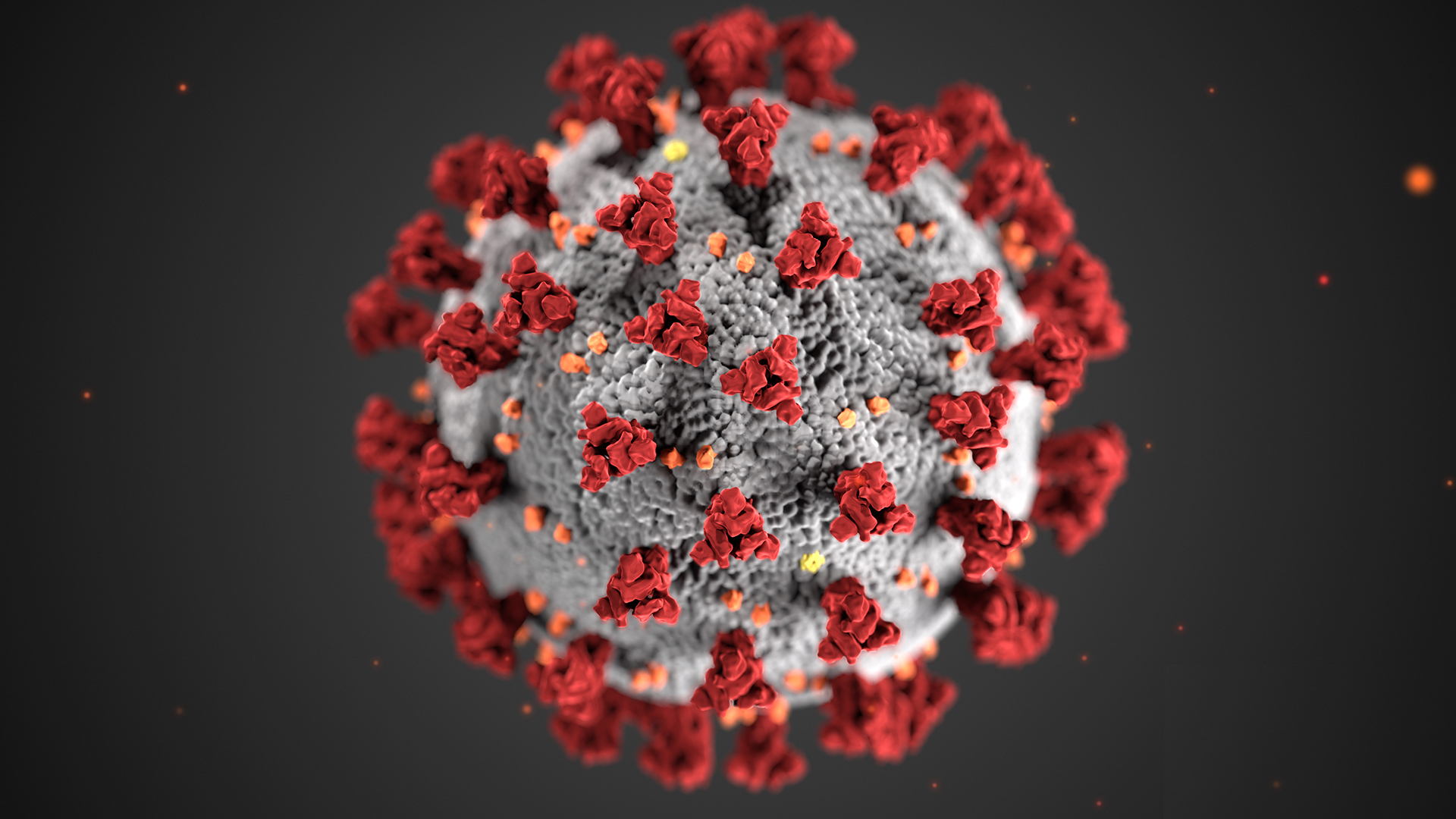
 Image result for coronavirus
It's March 16, 2020, and our nation - our world - is experiencing a global pandemic of a disease called, COVID-19, or "Coronavirus." As we are all dealing with the "new normal" of living under restricted conditions and closed schools and businesses,  I couldn't help but wonder what things were like, just over 100 years ago, when many of our ancestors lived (or died) under a similar threat - the "Spanish Flu" epidemic of 1918-1919. As I've read up on it, I've learned that not much is different now, than it was a century ago. Lack of preparedness, attempts at and orders for social distancing, and an overwhelmed healthcare system have been facets of both outbreaks.

This flu, also referred to as "the grippe" or "The Spanish Lady" struck the United States in multiple waves, at the exact same time as the height of World War One. Also, people were being hit with other diseases, such as typhoid fever and tuberculosis (which devastated my family), at the same time. (Several of my family members also died of a disease called pellagra, during this time. You can read more about that by clicking here.) The disease, though having gone down in history mostly known by the "Spanish Flu," moniker, actually first broke out in the United States, and was officially named, "Group A Influenza." Within months, it would spread worldwide, and eventually infect almost one-half of the earth's population. In North Carolina, where the bulk of my ancestors lived, over 13,000 souls were lost, including at least 17 physicians.
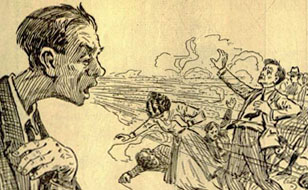
Health Bulletin cartoon
Detail of cartoon featured in October 1919 issue of the Health Bulletin.
A Blessing in Disguise
Another result of this deadly pandemic was that it brought about an explosion in community activism and volunteerism, another aspect that seems to be shared with our current crisis. Today, like in 1918-1919, neighbors are checking on one another, communities are banding together to be sure children and the elderly are fed and cared for, and various random acts of kindness are taking place, all over our cities. "People helping people" seems to one of our most patriotic and community-building acts, brought about in troubled times, but always showing the heart of our nation.

Though tragic in it's effect on the state, this influenza pandemic actually led to some positive and lasting outcomes in North Carolina. After exposing the inadequacies in the state's medical systems and lack of preparedness for an event such as this, this deadly influenza outbreak instigated organizational and structural changes in the immediate years that followed it. New hospitals were built, more specialized and comprehensive health institutions were created and/or former ones, like County Health Departments, were strengthened and given improved focus - especially on rural areas. And, perhaps most impactfully, it solidified the role of WOMEN in the field of medicine.
This Red Cross veil, from Wilmington, NC, was worn in 1918 during the WW1 flu pandemic that killed over 600,000 Americans.

I've searched my entire family tree (4610 people) and haven't found a soul for whom I have a death certificate whose cause of death was given as or caused by Influenza, in either 1918 or 1919. However, I do have at least 15 who died of pneumonia or, specifically, lobar pneumonia, during that period and, although the flu was not given as a contributory cause in any case, I imagine it could have been a possible instigator, in some. As mentioned above, my family members were stricken, severely, by pulmonary tuberculosis and pellagra. These two diseases caused no less than 25 deaths in my family, between 1912 and 1929, including that of my grandfather. But, that's a story for another post. 


How did the Influenza pandemic of 1918-1919 affect your family and/or the state or community in which they lived? Please share in the comment section, below. 

Thanks for reading, and please stay healthy and safe!

Renate

Addendum: I remembered, after posting this, that my paternal grandparents, Anna/Annie GREEN and Calvin YARBOROUGH had gotten married in 1919, so I took a look back to see what date that had occured on. Sure enough, their nuptials took place on February 23, 1919, right in the middle of the influenza pandemic. Interesting. Perhaps that accounts for why they were married at the home of the Baptist minister, instead of at the church, although that was not an uncommon thing to do at the time. But, maybe, just maybe it was because of the pandemic.

Bottom of marriage record for Annie Green and Calvin Yarborough, showing that they were married at the home of M.S. Stamps (I think), the Baptist minister, at his home near Louisburg, on February 23, 1919.
Three witnesses were present: Joe Leonard, JS Wiggins, and Mary Bell Davis.

Permalink to this post:  https://justthinking130.blogspot.com/2020/03/north-carolina-and-spanish-flu-pandemic.html
Sources:
Burns, Kevin, Flu Pandemic of World War I, North Carolina Museum of History, Digital Article. Accessed Mary 16, 2020 at 7:15 p.m.

Chase, Steven, "The Influenza Outbreak of 1918-1919," Revised by Lisa Gregory, NC Government and Heritage Library online article, accessed March 16, 2020 at 5:00 p.m.  https://www.ncpedia.org/history/health/influenza

Cockrell, David L. ""A Blessing in Disguise": The Influenza Pandemic of 1918 and North Carolina's Medical and Public Health Communities." The North Carolina Historical Review 73, no. 3 (1996): 309-27. Accessed March 16, 2020. www.jstor.org/stable/23521395.

Live Science, website, https://www.livescience.com/topics/live/coronavirus-live-updates. Accessed March 16, 2020 at 7:47 p.m.

McKown, Harry,  "October 1918 -- North Carolina and the 'Blue Death'," This Month in North Carolina History, October 2008.

Stasio, Frank and Magnus, Amanda, "What Have We Learned from the Flu Pandemic of 1918?, " WUNC, North Carolina Public Radio Program, "The State of Things," accessed online March 16, 2010 at 7:00 p.m.  https://www.wunc.org/post/what-have-we-learned-flu-pandemic-1918


Tuesday, March 10, 2020

Six Degrees of Separation - Maternal and Paternal Ancestors in Same Church: Who Knew?

Six Degrees of Separation
You know what they say about "six degrees of separation," right? According to Wikipedia.org, it's the idea that all people are six (or fewer) social connections away from one another.  Well, this belief has proven true, over and over again, in my research; and today's finding is no exception.

Family Origins
My father's family is mostly from Louisburg, Franklin County, NC. My mother's maternal side is originally from Littleton, NC (Halifax and Warren Counties at different times), but her line migrated to Norfolk, VA around the beginning of the 1900s. I have researched both sides, thoroughly, and that research is ongoing. Today, I was looking for information about one of my father's paternal aunts, Quinea/Queenie YARBOROUGH, and her husband, Rev. Joel W. KING. both of whom were originally from Louisburg. I'd discovered, some time ago, that Joel died in Norfolk, which intrigued me, so I was using my access to ProQuest's Historical Newspapers: Black Newspapers Collection to see if I could find mention of him (or Quinea) in the Norfolk Journal and Guide.

My initial search was a little frustrating, because most of the results were for another Rev. Joel King, the brother of Dr. Martin Luther King, Jr. However, once I added the middle initial, "W", and removed the "Rev." from my search, I ended up with one very eye-opening result. It was an article with the following headline: "Minister, Sister Will Receive Double Funeral." Whaaat? I went on to read the article and learned that it was, indeed, about the correct Joel King and that, sadly, he and his sister, who also lived in Norfolk, had passed just a day apart, both after "a long illness." The two were to be funeralized, together, on June 25, 1966, the same day this article ran.

So, what does this have to do with the "six degrees" rule? Keep reading to find out!

Jerusalem Baptist Church
Jerusalem Baptist Church, in Norfolk, VA, has been home to my mother's family since at least the 1930s. My grandmother, Mary Davis, began attending there, with her children sometime during that decade, and remained a faithful member until her death in 1986. My uncle, the late Howell Hill, Sr. was head of the Deacon Board (among other leadership roles) and was one of the church's most faithful and dedicated members for his entire life. Just last year, in May 2019, our family attended a beautiful recognition ceremony, held in his honor, at Jerusalem. My mother, though we lived across the bay, in Hampton, always maintained her connection to Jerusalem, and attended, from time to time, for special services. She also was invited to speak there on more than one occasion. All my life, I've known of my maternal family's tie to Jerusalem, and I remember, dearly, their pastor during my childhood years, Reverend T.M. Venable.


Here I am with my first cousins in May 2019, in the Fellowship Hall at Jerusalem. 
Our family showed up for  the service to honor my uncle, Howell Hill (seated center) for his lifetime of service at Jerusalem, in May 2019. Less than two weeks later, he went to heaven. 


What I didn't know about my family's connection to Jerusalem is that it also extended to my paternal side! Yes, in reading the article about the double funeral, I learned that my paternal ancestor, Quinea/Queenie YARBOROUGH King, along with her husband Joel, and his sister, Mrs. Louisiana Cooke, were all also members of Jerusalem, and thus, would have, without a doubt, known and interacted with my maternal family! This is amazing to me, and I can't help but wonder if any of my family members knew this!  After all, my mother and father met sometime around 1956-57. However, there is no evidence that my father ever attended services at Jerusalem with my mother, since she was living and working in Hampton by the time they met. They married in 1958 and my mom quickly joined my father in Bremerhaven, Germany, where he was stationed at the time. From there, they moved to Cleveland, OH and then to Hampton, VA, and I believe chances are slim that they would have "crossed the water" with their four children to go to church at Jerusalem.


Who Knew?
I have to believe that, although my parents didn't have their ceremony at Jerusalem, their union certainly would have been announced to the church. If Quinea and Joel were active church members, certainly their antennae would have been raised upon hearing that my mother married someone named YARBOROUGH, from Louisburg, and most assuredly she would have inquired of my grandmother about it, so I believe this connection must have been a known one, and just another of the many tidbits of information that no one ever bothered to share with me about our family. Quinea was, after all, my father's aunt. She was his (deceased) father's older sister. Oh, and not only did these two sides of my family share a church family, but they are also buried in the same cemetery - Calvary Cemetery, in Norfolk. The next time I go to visit my Norfolk ancestors' graves, I will definitely be visiting my native Louisburg family, also!

It's amazing to me, just to to think of this. Two parts of my very disjointed family, worshipping and serving in the same space at the same time - and no one, at least to my knowledge, seemed to have thought to mention this to me in all the interviews (inquisitions, really, lol) I conducted of my elder family members who might have known. It's another family history mystery, for me; but I'm so glad I uncovered it, today!

And the research continues....


Renate


Sources:

Wikipedia contributors. (2020, February 15). Six degrees of separation. In Wikipedia, The Free Encyclopedia. Retrieved 18:56, March 10, 2020, from https://en.wikipedia.org/w/index.php?title=Six_degrees_of_separation&oldid=940887573

Minister, sister will receive double funeral. (1966, Jun 25). New Journal and Guide (1916-2003) Retrieved from https://search-proquest-com.ezproxy.virginiamemory.com/docview/568893686?accountid=44788

Tuesday, December 3, 2019

More Questions Than Answers - My Grandfather's Social Security Application

Temporary Joy?
Today, I received a copy of the Social Security Application for my maternal grandfather, Daniel Webster Hill. I was so excited when I got the envelope from my mailbox, especially since I'd kind of forgotten I'd ordered this document. Daniel's life, as well as that of his mother and full siblings, has been challenging to document, either because of conflicting or absence of information.
1937 Social Security Application for Daniel Webster Hill
My hope, when I ordered this document was that it would provide conclusive data, so I was quite excited as I carefully tore open the envelope. Instead, its contents have led me to more questions as I try to uncover the true facts of my grandfather's life.

Dissecting the Document


Out of this entire document, only two items bore no concern; my grandfather's gender (male) and race (Negro). Everything else either provided confirmation of my research or conflicted with previous findings, thus inciting further questions that will need to be answered.

Name (Red):Thankfully, this document confirms my grandfather's full name: Daniel Webster HILL.

Address (Purple and Brown): This was the first issue on the document. The address given is not the address of the home in which my grandparents lived while they were together. Family lore has always been that my grandfather left (abandoned) the family when my mother was 4 and her brother was 7. That would have been sometime between September 10, 1938 and March 23, 1939. However, this application is dated February 25, 1937, which precedes that date range by over a year and a half, making my mother not even 3, yet, and her brother, only 5. The only thing I can think is that perhaps he came back after this date, before leaving for good.
BUT.... there's another thing these two items actually corroborate for me! My late uncle, Howell Hill, who I interviewed numerous times about his and my mother's family and ancestry, told me something I haven't forgotten. In describing what he recalls as a domestic abuse situation between Daniel and my grandmother, Mary, my uncle told me how when Daniel Hill first left them, he just moved into a room in the house next door, and they would see him watching them from an upstairs window. He expressed how afraid this made him, because Daniel Hill "was so mean". Well, I used google maps to look up the address on the SS application, and, lo and behold, 1301 W. 42(nd) St. is right next door (though across a small street) to my grandmother's house, 1273 W. 42nd Street.

In this current-day photo from Google Maps, the house on the left (1273) is the house my mother grew up in. The house on the right (1301) is the house Daniel Hill was living in at the time he filled out his Social Security application. Notice the upstairs side windows on this house, which directly face my grandmother's home, making my uncle's story seem quite likely to be true.

Employment (Yellow/Blue): In 1930, according to the Census, my grandfather was working as a Longshoreman at the Pier (usually meaning Lambert's Point). However, at the time of his SSA, he states that he's unemployed. Could this have been part of the issue that played into the problems he and my grandmother were (apparently) having? Also, Item 13 indicates that Daniel was registered as an employee with the W.P.A., something I wasn't aware of and will need to research further.

Age (Orange): Daniel Hill's true birth year has been an issue since I began researching him, many years ago. It seems that he began using this 1885 birth year around the time he married my grandmother. He was much older than she, so perhaps this was his way of smoothing that out. I really don't know. But, Daniel shows as a one-year-old in the household of his parents in 1880 and, in 1900, he is a boarder in the home of his mother and stepfather, enumerated as 20 years old with a birthdate given as March 1879. It's not until after his 1926 marriage to my grandmother that I first see him being referred to as a younger man -- with his age being enumerated in 1930 as 40, with whoever gave the information stating that he'd been 36 at the time of his first marriage. From this point on, any documents I've found on Daniel Hill give him this younger age.


1880 Census showing one-year-old Daniel W. in the household with his parents and sisters, in Tyrrell County NC. Birthplace is given as North Carolina for the entire family.
Place of Birth (White): I have seen Daniel's place of birth given as Virginia on other documents, but I'm confused about that, since I know the family (both his mother and father) were from North Carolina, and he is enumerated with them, at just one year old, in that state. However, I guess it is possible that his mother could have been in Virginia (for some reason) when he was born, though I really doubt it. He lists "Gilmerton, Norfolk Co., VA" as his birthplace on this application. This is, indeed, where his mother, Pinkey, later lived and ran a boarding house with his stepfather, and where, according to the newspaper announcement of her death, she was buried, but she doesn't appear there before 1900. Perhaps she was visiting a family member at the time of his birth, just as she was at the time of her death? This will require further research.

Death notice from Norfolk, VA Journal and Guide, announcing the death of Pinkie (Hill) Howell

Parents' Names (Green/Pink) - Daniel confirms his parent's names. but with exceptions. His father was known as "Henry" Hill, but his full name was actually Charles Henry Hill. (I think it's quite possible that Daniel may not have known that.) His mother, Pinkie's, maiden name has been another source of confusion. She'd been enslaved on Somerset Plantation, in Creswell, NC, which was owned by the COLLINS family. Her father was Mack TREDWELL, but sometime prior to Emancipation, her mother married a man named Peter KING. Pinkie has been recorded as using each of those surnames on different documents, so it's hard to know which (if either) was actually her "legal" maiden name. It does seem clear, though, that she considered Peter King to be her father figure and that seems to be what Daniel understood, also, according to this document.

Social Security Applications are typically very useful documents for genealogists; however, as this one shows, sometimes that usefulness can provide a mixture of evidence-types for the researcher: direct and indirect, consistent or conflicting, and, sometimes, negative or even absent. A careful researcher will study all of the information on a document, analyzing each item and following up with further research to work towards solving conflicts and/or filling in blanks. This SSA for my grandfather, Daniel W. Hill certainly is leaving me with more work to do, but I am up to and looking forward to the challenge!

Thanks for reading,
Renate

Sources:
 United States Social Security Application, Form SS-5, Treasury Department, Internal Revenue Service: Daniel Webster Hill, February 25, 1937.

United States Federal Census, Year: 1880; Census Place: Scuppernong, Tyrrell, North Carolina; Roll: 983; Family History Film: 1254983; Page: 269D; Enumeration District: 134; Image: 0453.

New Journal and Guide (1916-2003); June 1, 1929; ProQuest Historical Newspapers: Norfolk Journal and Guide, p. 4

Link to Google Maps:


Permalink to this post:
https://justthinking130.blogspot.com/2019/12/more-questions-than-answers-my.html


Monday, September 30, 2019

Renate Yarborough Sanders - Speaker Profile

I am an experienced teacher and genealogy presenter, available for speaking engagements, both in-person and virtually! Please email me at yarsan@aol.com for information about availability and fees. I would love to be considered as a speaker for your next event!

Speaker Bio

Renate Yarborough Sanders has been engaged in genealogy research since 1997 and has been giving genealogy related presentations, to a variety of audiences, since 2012.  She is the descendant of formerly-enslaved ancestors, as well as enslavers and free people of color. Renate is the author of two blogs: “Into the LIGHT”, which focuses on her own family history; and, “Genea-Related”, which is a platform for presenting a variety of information of genealogical interest.  Renate also produces a “(Mostly) African-American Funeral Programs” online database, in which she publishes vital data extracted from funeral programs. For a more extensive bio, please email Renate at yarsan@aol.com.
----------------------------------------------------------------------------------

Image result for microphone    Current Topics:
       Finding Calvin: Following My Enslaved Ancestor Through Multiple Owners: A Case Study
In this presentation, the researcher models the process used in verifying an ancestor’s slavery status, and shares the methodology and documents used to document his owners during 25 years of enslavement.

Researching Free People of Color in Antebellum Years: 1800 – 1865
Discussion of the lives and circumstances of FPOC in the states of North Carolina and Virginia, the laws enacted to exert increasing control over them, and a look at useful record types for researching this population. (This talk can be broadened to include other areas.)

       The Case for DNA: Why Should I Test?
Are you on the fence about DNA testing? Do you wonder if the results are “real” or if they can truly help you to further your genealogy research? Participants will learn about the main types of DNA testing, and how each can help to inform genealogical research. Examples of real-life DNA success stories will also be shared.

        Getting Started with Genealogy Research
How does one get started with genealogical research? Today’s technological advances make it easy! Getting started means going from what you know, to using a variety of resources – in person and online – to discover the unknown. Learn about common record types, and how to access them, in this informative workshop!

     Getting More Out of Your Genealogy Research: Methods, Documents, and Websites
An in-depth exploration how to extract information from certain types of documents, as well as a modeled approach to using some of the more popular websites for genealogical research. This session can be extended include an additional “Part 2” hands-on workshop, with participants on computers, for an added fee.

         Researching Enslaved Ancestors
The presenter shares and models best practice and methodology for researching formerly enslaved ancestors. Participants learn about helpful record types and web sites and how to extract data about the enslaved from records of slave-owning communities.

         Researching Formerly Enslaved Ancestors: It Takes a Village!
This talk is designed for descendants of antebellum property owners, particularly those who enslaved other humans. The focus is on how descendants of slave owners are crucial to and can assist in the efforts of those researching the formerly enslaved.

         Researching Ancestors of Color
This session is specific to researching ancestors of color, to include formerly enslaved and free people of color. Participants learn which record types and web sites are most helpful in this type of research and how to extract data about people of color from various document types.

         Using Funeral Programs to Inform Genealogy Research
Funeral Programs are often rich with genealogical information. In this talk, the presenter will dissect the parts of commonly used funeral programs, and model how to extract important genealogical information and clues from these valuable documents.                                                    

In Their Own Words: Genealogy in the Slave Narratives                    Uncovering the genealogy of the formerly enslaved can often be challenging; but sometimes, the information is left in first-hand accounts, commonly known as "Slave Narratives.” From books, to projects set up to learn about life during slavery, researchers can find an abundance of genealogical and other information about enslaved families, their owners, and their communities - straight from the mouths of the Ancestors.
---------------------------------------------------------------------------------------------------------------

Remember: Email yarsan@aol.com to book me for your upcoming event!

Renate

Permalink to this post: https://justthinking130.blogspot.com/2019/09/speaker-bio-renate-yarborough-sanders.html

Monday, July 8, 2019

A Military HERO On My Tree! Ernest Roland Morgan

Up All Night
Wow. I guess there's something to be said for going down a genealogical rabbit hole at 4:30 in the morning, after being up all night!

Since I was sleepless, I decided to work on tracking down the families of some of the mysterious people who were named in my elusive grandfather's, 1940 will. In doing so, I uncovered the names of the grandchildren of his second-cousin, Lillian Batts Melton, whom he'd left all of his real and personal property to. One of her descendants was her grandson, Ernest Roland Morgan, who, in 1940, was living in her home, along with his mother, Evelyn, and brothers, Harry and Sherman. His uncles, LeRoy and Larry, were also in the home. My grandfather, Daniel Webster Hill, who died on June 7th of that year, had also lived there, and should have been listed, since the enumeration date was to have been May 1, however, it's a possibility he may have been out of the home and "shacked up" elsewhere, at that time. (Another story for another time...)

Year: 1940; Census Place: Petersburg, Petersburg City, Virginia; Roll: m-t0627-04316; Page: 7A; Enumeration District: 115-21, retrieved from Ancestry.com 7/8/2019 at 4:46 a.m.
After discovering all of these previously-unknown-to-me names, I began to follow-up and research each individual. After just a few minutes, I was stopped dead in my tracks as I began to get hint after hint about Ernest Roland Morgan. It was clear that he'd followed in his own father's military footsteps, but information from his death records, as well as subsequent obituaries and newspaper clippings I ran across, showed me that Ernest was no run-of-the-mill, ordinary man. No, this cousin of mine was ALL THAT and a bag of (military) chips! And for me, this is an anomaly for my tree - a tree that's filled with a lot of wonderful people, who did much good in the world, but who were mostly behind the scenes worker-bee types (like me), not those who shine in the spotlight and get tons of recognition and/or accolades. That just isn't who my family's been - and I'm okay with that - but, Cousin Ernest? Cousin Ernest was a STAR!

*Military Accomplishments
Ernest Roland Morgan, General, United States Army (retired) was born March 29, 1932, and he was called back home November 21, 2001, following knee surgery in Huntsville, Alabama. He made national headlines in 1975 when he was captured in Beirut, Lebanon by Lebanese terrorists and released 13 days later.
He went on to become the Adjutant General of the D.C. National Guard and finally the Commanding General of the National Guard of the U.S. Virgin Islands. His military career spanned 35 years. He had a tour of duty in Korea and in Vietnam and retired in 1987.

*Buried at Arlington National Cemetery

MORGAN, ERNEST ROLAND 
MG   US ARMY 
KOREA, VIETNAM 
DATE OF BIRTH: 03/29/1932 
DATE OF DEATH: 11/21/2001 
BURIED AT: SECTION 66  SITE 6267-1 
ARLINGTON NATIONAL CEMETERY

(The preceding excerpts were taken from http://www.arlingtoncemetery.net/ermorgan.htm. PLEASE click the link to read the full tribute page from Arlington National Cemetery.)

*Appointed Adjutant General of the Militia of the District of Columbia

This next blurb from "Public Papers of the United States: Ronald Reagan, 1981 tells about Cousin Ernest's appointment as Adjutant General of the DC National Guard.

Source: Public Papers of the Presidents of the United State: Ronald Reagan, 1981. Published by Best Books on, 1982
*Abducted and Prisoner of War for 13 Days

Sunday, March 3, 2019

What's What in the United States Census?

As a professional researcher I often get questions from those who are just getting started, as well as from fellow genealogists who've been at it just as long as I have. These questions come by way of emails, Facebook messages, texts, and phone calls. One thing I've noticed, consistently, is that I'm often asked about where information about an ancestor might be found, and the answer is a simple, "In the ____ Census".

The United States Federal Census has been taken every ten years, since 1790. Most people know that. However, what many fail to realize is that no two Census years are identical in the information that was collected. As researchers, it's so important to familiarize ourselves with the questions that were asked in each census year; and, not only that, but to also be aware of the many supplemental census documents that are available from various years. Being armed with this information will move us forward in our research in a more informed way, and can help to eliminate the frustration of trying to find certain valuable nuggets of information which might be just one quick click away.

For a very comprehensive listing of what is included in each census year, as well as what other schedules (such as slave, mortality, agricultural and more) are available, please visit this excellent source from The Family History DailyThe Ultimate Quick Reference Guide to the U.S. Census for Genealogy  Although I did find one error - that the 1850 and 1860 Slave Schedules are exactly the same - this guide includes a wealth of information about what is included in each enumeration, for each census and supplemental schedule. Though all data collected in census documents needs to be corroborated from other sources, the U.S. Census is a valuable starting point for most who engage in genealogical research.

Additional sources for understanding census rules and enumeration can be found at these links:


Happy researching!
Renate

Permalink to this post: https://justthinking130.blogspot.com/2019/03/whats-in-census-and-when.html

*All sources are linked in the post, above.


Sunday, February 24, 2019

A Carolina Weekend!

This weekend, I had the opportunity to give two presentations as the "Featured Speaker" for a genealogy symposium in Charlotte, NC. Held at the beautiful Friendship Missionary Baptist Church, the event was cosponsored by the church's African American Heritage Ministry, Afro American Historical and Genealogical Society (AAHGS), and Comprehensive Genealogical Services.

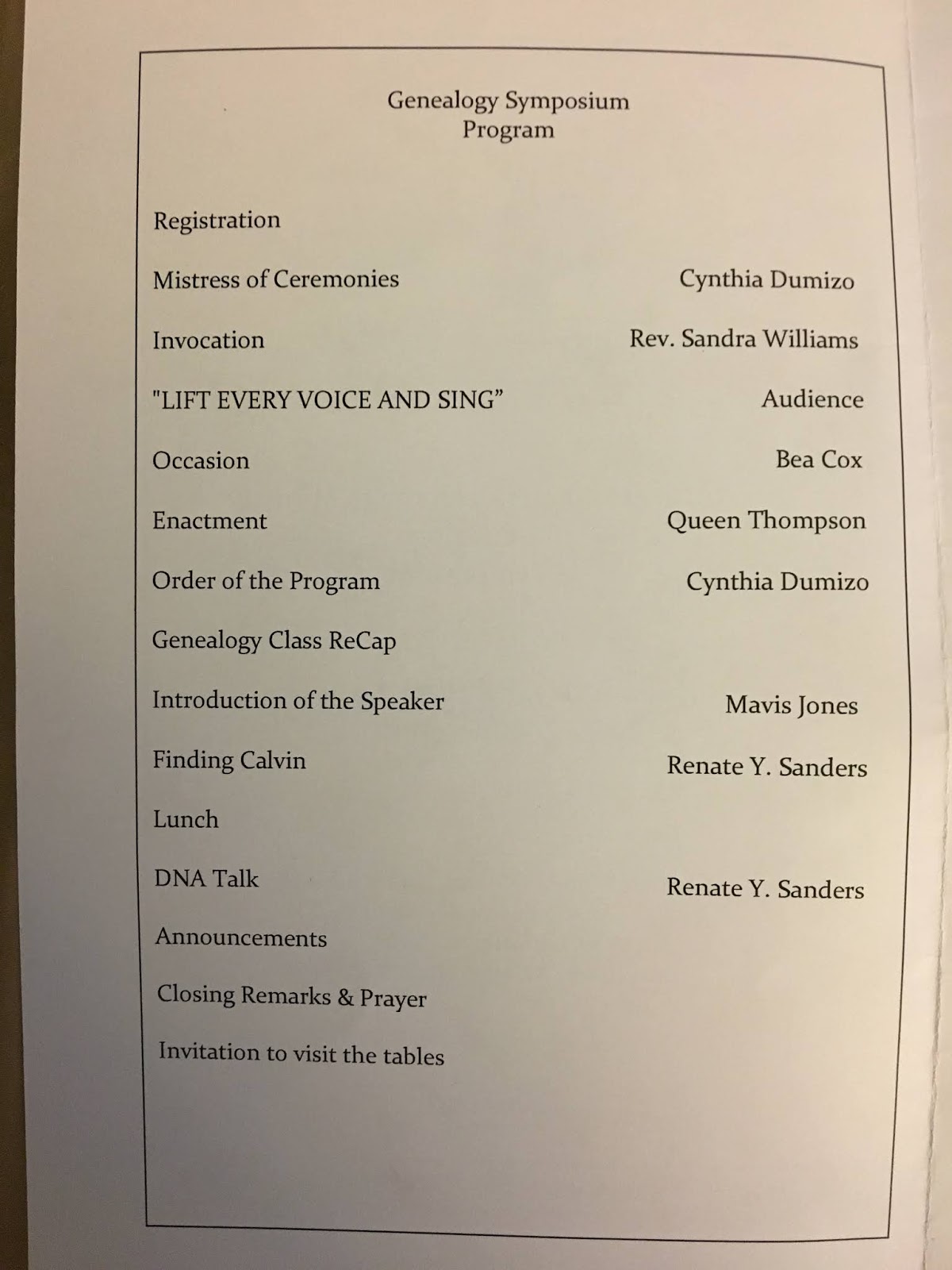
The day-long symposium, to which registration was open to the public, was the culminating event for the conclusion of 5 weeks of genealogy classes which had been held at the church, in which upwards of 50 students had been enrolled. The day included a period reenactment by a descendant of a formerly enslaved woman, recap sessions for the members of the two classes (beginner and intermediate), lunch, and two presentations by yours truly - "Finding Calvin: A Case Study" and "Introduction to DNA for Genealogy". Both presentations were extremely well-received and were followed by tons of compliments and expressions of gratitude from audience members. And, guess what? At the end of the day, I received an enthusiastic standing ovation - a first for me in the 7 years I've been giving genealogy talks!
                    
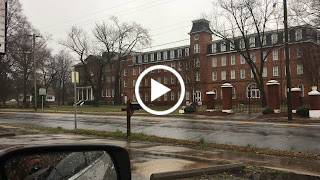
The weekend was made particularly joyful and memorable for several other reasons, the most special of which was the fact that I got to spend time with FAMILY and FRIENDS.  On Friday, my second cousin on my Green-Hawkins line, Kelly, who lives just outside of Charlotte in Mathews, picked me up and, after we got a quick bite to eat, rode me around to a couple of places I wanted to see - Johnson C. Smith University, where my aunt, Susie Yarborough, was a dorm matron in the 1940's and 50's; and Barber Scotia College, a school I recently discovered that my ancestor, Jessie Green, attended sometime between around 1916 -1920. (You can read about that, here.) Kelly and I had a lovely few hours together, and I'm ever-so-grateful that he so generously took the time to spend with me and to ride me around in the rain. After my afternoon with Kelly, I met up with a dear friend of 40 years and college sorority sister, Debbie, who lives right there in Charlotte. We had a great time catching up over a yummy dinner at the Rock Bottom restaurant.
        
With my cousin, Kelly
With my Soror Debbie
Then, on Saturday, Kelly attended the entire day of the genealogy event, just to support me! But, seeing Kelly wasn't the only "relative-treat" I got on this trip. Also on Saturday, I actually had the pleasure of meeting another second cousin - this one on my Yarborough line - for the very first time! Cousin Eunice and I have been communicating by phone, email, and Facebook for many years and she (and her brother, Samuel) even graciously tested their late mother - my father's first cousin - to assist in furthering my research.  On Saturday, she too came to support me and to hear my talk about our shared ancestor, our great-grandfather, Calvin; and she also stayed the whole day! Meeting my cousin was such a pleasure! I look forward to seeing her, again!
     
With my cousin, Eunice
Having these two cousins present at the symposium on Saturday was amazing, in itself, but it also constituted a first, for me. I've been giving genealogy-related presentations since 2012, but this was the first time any member of my family has ever been in my audience. To have not one, but two family members present - representing different lines, at that - warmed my heart to no end. And, to top off my "family time" for the weekend, I was able to make a quick stop at Kelly's house, on my way out of town, to see his wife, Michelle, and my young cousins, William and Sydney. This brief, but pleasurable visit was the icing on the cake of a great visit to Charlotte!

Here are a few additional photos from my trip. I do hope to return to the "Queen City", someday, for a longer (drier) visit. I had a great time! :)
                     
Barber Scotia College
Graves Hall at Barber Scotia


Corner entry and sign for Johnson C. Smith University
Marker on JCS campus honoring one of the
founders of my sorority


View of Charlotte Uptown from my
 hotel room window

Cousins!!!!


Thanks for reading!
Renate